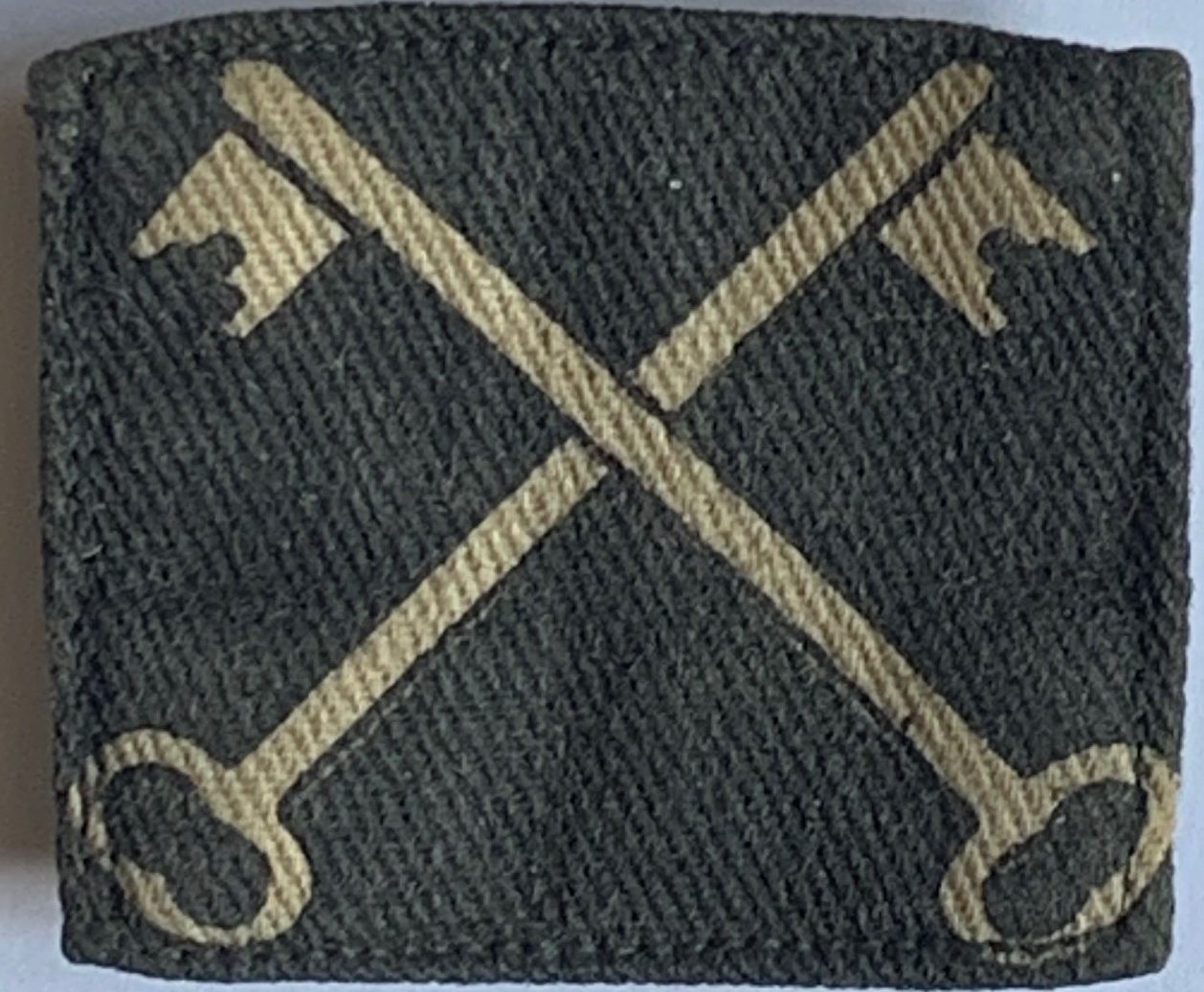
The Victoria Cross (VC) is the most prestigious British medal & is awarded for
“… most conspicuous bravery, or some daring or pre-eminent act of valour or self-sacrifice, or extreme devotion to duty in the presence of the enemy”.
The first VCs were presented by Queen Victoria in 1857 & most have been personally presented by the British monarch, usually at Buckingham Palace.

The Kohima Museum tells the stories of twenty of the VCs that were won during the Burma Campaign. Some of those stories are described below.


Two VCs were won during the Battle of Kohima, by Captain John Randle & Lance Corporal John Harman.
Captain John Randle VC
John Niel Randle, known as ‘Jack’, was born in Benares, India, in 1917. His family moved to Oxford in 1920, where his father was a Professor of Philosophy.

Randle went to Marlborough School & then studied Law at Merton College, Oxford, graduating in 1939. He was a boisterous undergraduate.

Although he was called up shortly before the declaration of war, Randle’s legal training was put to use in the army defending soldiers at court-martial proceedings. He was commissioned as a Second Lieutenant & joined the 2nd Battalion Royal Norfolk Regiment in May 1940. The Battalion embarked for India in April 1942, with the 2nd Infantry Division.

After a long period of training in South West India, 2nd Division was thrown into the Battle of Kohima in April 1944. By this time, Randle had been promoted to temporary Captain. He was awarded the Victoria Cross for his conduct during the Norfolk’s attacks on Transport Ridge. It was detailed in a citation in the London Gazette:
‘On the 4th May, 1944, at Kohima in Assam, a Battalion of the Royal Norfolk Regiment attacked the Japanese positions on a nearby ridge. Captain Randle took over command of the Company which was leading the attack when the Company Commander was severely wounded. His handling of a difficult situation in the face of heavy fire was masterly & although wounded himself in the knee by grenade splinters he continued to inspire his men by his initiative, courage & outstanding leadership, until the Company had captured its objective & consolidated its position. He then went forward & brought in all the wounded men who were lying outside the perimeter.
In spite of his painful wound Captain Randle refused to be evacuated & insisted on carrying out a personal reconnaissance with great daring in bright moonlight prior to a further attack by his Company on the position to which the enemy had withdrawn.

At dawn on 6th May the attack opened, led by Captain Randle, & one of the platoons succeeded in reaching the crest of the hill held by the Japanese. Another platoon, however, ran into heavy medium machine gun fire from a bunker on the reverse slope of the feature. Captain Randle immediately appreciated that this particular bunker covered not only the rear of his new position but also the line of communication of the battalion & therefore the destruction of the enemy post was imperative if the operation was to succeed. With utter disregard of the obvious danger to himself, Captain Randle charged the Japanese machine gun post single-handed with rifle & bayonet. Although bleeding in the face & mortally wounded by numerous bursts of machine gun fire, he reached the bunker & silenced the gun with a grenade thrown through the bunker slit. He then flung his body across the slit so that the aperture should be completely sealed.
The bravery shown by this officer could not have been surpassed & by his self-sacrifice he saved the lives of many of his men & enabled not only his own Company but the whole Battalion to gain its objective & win a decisive victory over the enemy.’

Although the citation claimed that the Battalion won a “decisive victory” in this action, the reality was rather different. The bunker complex they had attacked, which became known as the Norfolk Bunker, remained in enemy hands for another six days, until it was finally stormed on May 12th by 1st Royal Scots with tank support. Jack Randle’s body had lain unburied during this time.

The night before he died, Randle had said to a fellow officer:
“If I do not come back, make it all right with Mavis & the kid, will you?”

Mavis was his wife. Her brother Leslie Thomas Manser was in the Royal Air Force & was killed in 1942 in a bombing raid over Cologne in Germany, for which he was also awarded the Victoria Cross.

Lance Corporal John Harman VC
John Pennington Harman was born in Beckenham, Kent, in 1914, son of a city financier, Martin Coles Harman.

In 1925, Martin Harman bought Lundy, an island three & a half miles long & half a mile wide in the Bristol Channel off the coast of Devon. He declared it “a self-governing dominion of the British Empire, recognising King George as its head”.
As part of his vision of the island as a dominion, Martin Harman introduced Lundy stamps, which are still in use today, by arrangement with the British Post Office; the price of a Lundy stamp covers the cost of UK postage plus the cost of ferrying from the mainland. It is the oldest private postal service in the world.

The name Lundy is derived from Puffin Island in Norse & Martin Harman invented a currency denominated in puffins. He had puffin coins minted in 1929, with his head on them, instead of the King’s. The legality of this was challenged in the High Court in 1931 & he was compelled to withdraw the coins.

John Harman did not settle at school, preferring to spend his time on Lundy, where he enjoyed farm work. He is reported to have said:
“When I grow up, I don’t want to work my guts out. I want to enjoy my life.” (19)

In search of adventure, he worked on farms in Australia & New Zealand. On his passport, he described his profession as ‘Retired beekeeper’.

John Harman enlisted in the army in 1941 & ended up in the 4th Battalion, Queen’s Own Royal West Kents. He disliked army discipline, but showed initiative & leadership which earned him promotion to Lance Corporal. However, he remained a conspicuous maverick.
As part of 5 Division, the West Kents were sent to the Arakan region of northwest Burma in 1944. Harman enjoyed scouting there & displayed indifference to danger, remaining calm when exposed to fire. He told his company commander Major Donald Easten:
“I’m going to live to be at least 79.” (19)
This belief was based on prophesies made by fortune tellers.
In April, the West Kents found themselves on Kohima Ridge, surrounded by the Japanese 31st Infantry Division. John Harman was involved in the defence of Detail Hill. On April 9th, daylight revealed that, during the night, Japanese with a machine gun had occupied a bunker 50 yds behind the West Kents’ trenches, higher up the hill. John Harman crawled alone towards the bunker & then sprinted the last few yards, despite bullets all around him, & killed its occupants with a grenade. He carried the machine gun calmly back down the hill, to cheers & applause.
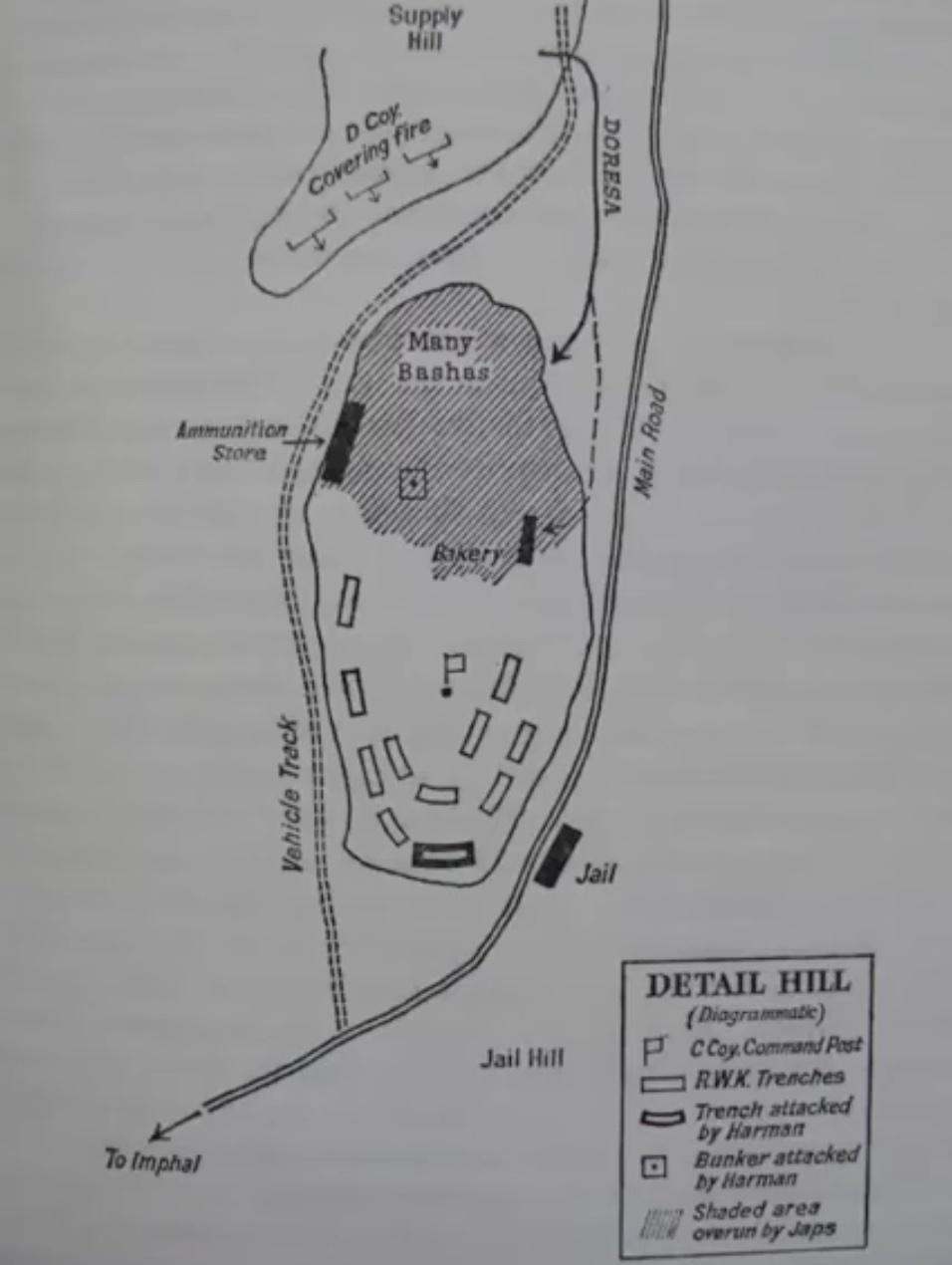
When the sun rose next day, five Japanese were seen setting up a machine gun in a vacant British trench at the bottom of the hill. Harman ordered covering fire & then charged down the hill, dodging bullets from the Japanese. He stopped a few yards short & shot four, firing his rifle from the hip, before bayoneting the fifth.

Triumphantly, he brandished their machine gun & smashed it to the ground, enjoying cheers from the British. Then he sauntered back up the hill, ignoring shouts to run. A burst of fire from Jail Hill hit him in the spine. Major Easten ran to him & pulled him under cover:
“I shouted for stretcher bearers, but he actually died in my arms before they arrived.” (11)
John Harman’s last words were:
“Don’t bother. I got the lot. It was worth it.” (19)
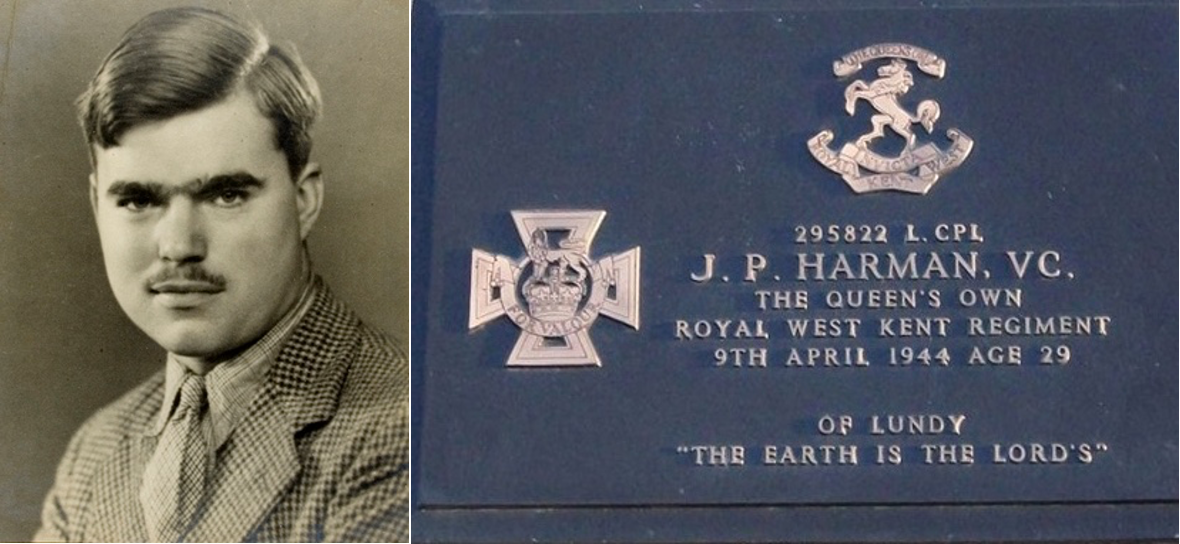
John Harman was awarded a posthumous Victoria Cross. The citation in the London Gazette was as follows:
‘On 8/9 April 1944 at the Battle of Kohima, British India, Lance-Corporal Harman was commanding a section of a forward platoon where soldiers of the Imperial Japanese Army had established a machine-gun post within 50 yards of his company and were becoming a menace. Since it was not possible to bring fire on to the enemy post, the lance-corporal went forward by himself and threw a grenade into the position, destroying it. He returned carrying the enemy machinegun as a trophy. Early next morning, having ordered covering fire from his Bren gun team, he went out alone, with a Lee–Enfield rifle with fixed bayonet and charged a party of Japanese soldiers who were digging in. He shot four and bayoneted one. On his way back, Lance Corporal Harman was severely wounded by a burst of enemy machine-gun fire and died soon after reaching British lines.’

In 1949, John Harman’s father unveiled a small memorial to his son on Lundy. Invitations were sent to surviving West Kents.

The ceremony was attended by the island’s population of sixteen, one hundred invited guests and about six hundred day visitors.

The memorial is a slab of blue-grey stone, set on a granite base in a disused quarry that was one of John’s favourite spots.

A webinar by Stephen Snelling describing the heroism of John Harman & Jack Randle, the other VC recipient at Kohima, can be found by clicking here.
Major Charles Hoey VC
Charles Ferguson Hoey was born in 1914 on Vancouver Island, the son of Irish-British immigrants. His grandfather had been a Major-General.
Charles Hoey volunteered at age 16 for the Canadian Militia. In 1933, he left for Britain & joined the Queen’s Own Royal West Kent Regiment. He was nominated for the Royal Military College, Sandhurst. On graduation, he was commissioned into the The Lincolnshire Regiment, in which his grandfather had been a colonel.

Hoey went to India with his battalion in 1937. In March 1943, he was awarded the Military Cross for his conduct during a raid on Japanese positions at Maungdaw, in the Arakan region of Burma.

The following year, he was killed on 16 February at the Ngakyedauk Pass, leading his company to relieve the Admin Box, that was surrounded by Japanese. His conduct won a posthumous Victoria Cross. An abridged version of his citation in the London Gazette reads:
“In Burma, on February 16th 1944, Major Hoey’s Company formed part of a force which was ordered to capture a position at all costs.
After a night march through enemy-held territory, the force was met at the foot of the position by heavy machine-gun fire. Major Hoey personally led his company under heavy fire right up to the objective. Although wounded at least twice in the leg & head, he seized a Bren gun from one of his men &, firing from the hip, led his company on to the objective. In spite of his wounds, the company had difficulty in keeping up with him, & Major Hoey reached the enemy strong-post first, where he killed all the occupants before being mortally wounded.
Major Hoey’s outstanding gallantry & leadership, his total disregard of personal safety, & his grim determination to reach the objective resulted in the capture of this vital position.”

He is buried in Taukkyan War Cemetery. In his hometown, a school & a park were named in his honour.
Subedar Netrabahadur Thapa VC
Netrabahadur Thapa was born in 1916 & enlisted with the 5th Royal Gurkha Rifles (Frontier Force) in 1932.

His battalion formed part of 17th Indian Division, which was responsible for defending Imphal against attacks from the south by the Japanese 33rd Division during the Battle of Imphal.

The following is an edited version of the citation published in The London Gazette on 10th October 1944.
‘Subedar Netrabahadur Thapa commanded a garrison of 41 men of 2/5th Royal Gurkha Rifles which, on the afternoon of 25th June 1944, took over the isolated piquet known as Mortar Bluff on a hillside commanding the base at Bishenpur. The piquet, completely devoid of cover, was overlooked by high ground nearby, which had been over-run by strong enemy forces on the previous night. Owing to its commanding position, retention of Mortar Bluff was vital to the safety of Bishenpur.
The relief was harassed by snipers at close range, but was completed at 1830 hours without casualties. An hour later, a 75mm & a 37mm gun were brought up to the high ground overlooking the position & poured shells at point blank range for 10 minutes into the narrow confines of the piquet. This was followed by a determined attack by a company of Japanese. A fierce fight ensued, in which Subedar Netrabahadur Thapa’s men, exhorted by their leader, held their ground against heavy odds & drove the enemy back, with disproportionate losses. During this time, Subedar Netrabahadur Thapa, with tireless energy & contempt for his own safety, moved from post to post encouraging his men & tending the wounded.

Under cover of the pitch-dark night & torrential rain, the enemy moved round to some jungle, from the cover of which they launched their next attack. In considerable strength, determined & ferocious, they poured from the jungle across the short space of open ground to the piquet defences under cover of small arms & 37mm gun fire from a flank. For a time our men held their ground until both machine guns of one section jammed.

With much reduced fire-power, the section was unable to hold on & the enemy over-ran this & another section, killing or wounding 12 of the 16 men comprising the two sections. Having no reserve, Subedar Netrabahadur Thapa himself went forward from his Headquarters & stemmed any further advance with grenades.
With most of his men casualties, ammunition low & the enemy in possession of part of his perimeter, Subedar Netrabahadur Thapa would have been justified in withdrawing, but he reported to his Commanding Officer that he intended to hold on & asked for reinforcements & ammunition.

So efficient were his plans for defence & such was the fine example of this gallant Gurkha officer that not a man left his trench & not a yard more ground was gained by the enemy, despite their desperate attempts. Thus the night passed until at 0400 hours eight men arrived with grenades & ammunition. Their arrival drew fire & all eight were soon casualties. Undismayed, Subedar Netrabahadur Thapa retrieved the ammunition & with his platoon Headquarters took the offensive armed with grenades & kukris. Whilst so doing, he received a bullet wound in the mouth. Shortly afterwards, a grenade killed him. His body was found next day, kukri in hand, with a dead Japanese by his side with a cleft skull.

True to the traditions of the service & his race, Subedar Netrabahadur Thapa had fought against overwhelming odds for 8 hours before he was killed. His fine example of personal bravery & his high sense of duty so inspired his men that a vital position was held to the limit of human endurance.’

Netrabahadur Thapa is commemorated on the Rangoon Memorial at Taukkyan War Cemetery, Yangon, Myanmar. His Victoria Cross was presented in January 1945 to his young widow, Nainasara Magarni, by Field Marshal Lord Wavell, the Viceroy of India. In the same ceremony, a VC was awarded to Naik Agansing Rai for his conduct at Mortar Bluff, where Netrabahadur Thapa gave his life.
Naik Agansing Rai VC
Agansing Rai was born in 1920 & joined the 5th Royal Gurkha Rifles (5RGR) in 1941. In 1944, he was a section commander with 2nd Battalion 5RGR, part of 17th Indian Division.
In June 1944, 2/5RGR was at Bishenpur fighting the Japanese advance in the Battle of Imphal. On June 26, C Company was ordered to retake two positions, dubbed Water Piquet & Mortar Bluff. These had been recently captured, despite a heroic defence led by Subedar Netrabahadur Thapa, who was posthumously awarded a VC for his conduct on June 25. Water Picquet & Mortar Bluff were 200 yards apart & supported each other. On one side lay dense jungle & on the other open ground up a slippery ridge, in full view of the enemy.

Naik Agansing Rai was awarded a VC for his part in retaking these positions. An edited version of the citation is as follows:
‘On 24th & 25th June, 1944, after fierce fighting, the enemy, with greatly superior forces, had captured well-sited & mutually supporting positions known as Water Piquet & Mortar Bluff. Their possession threatened our communications.
On 26th June, C Company of 2/5 RGR was ordered to recapture these positions. The attack suffered many casualties & was pinned down 80 yards from its objective by fire from a machine-gun on Mortar Bluff & a 37mm gun in the jungle.

Naik Agansing Rai led his section under withering fire directly at the machine-gun & captured it, himself killing three of the crew. Inspired by this bravery, the section surged forward & routed the garrison of Mortar Bluff. This position was now under intense fire from the 37mm gun in the jungle & from Water Piquet.
Naik Agansing Rai advanced towards the gun, his section without hesitation following their gallant leader. Intense fire reduced the section to three men before half the distance had been covered, but they pressed on. Naik Agansing Rai killed three of the crew & his men killed the other two. They then returned to Mortar Bluff where the rest of their platoon were forming up to assault Water Piquet.

On advancing, heavy machine-gun fire & showers of grenades from an isolated bunker caused further casualties. With indomitable courage, Naik Agansing Rai advanced alone with a grenade in one hand & his Thompson Sub-Machine gun in the other. Through devastating fire he reached the enemy position & killed all four occupants of the bunker.
The enemy now fled, demoralized by this NCO’s calm display of courage & complete contempt for danger. Naik Agansing Rai’s magnificent display of initiative, bravery & leadership, so inspired the rest of the Company that, in spite of heavy casualties, the result of this important action was never in doubt.’

Agansing Rai received his Victoria Cross from Field Marshal Lord Wavell, Viceroy of India, in January 1945. In the same ceremony, the widow of Netrabahadur Thapa received his VC, awarded for his heroic defence of Water Bluff on June 25th 1944.
Agansing Rai later became an instructor at the 5RGR regimental centre. He remained with the Indian Army after 1947, serving as Subedar Major with his battalion in the Congo in 1962-63, as part of the United Nations Force there. On retiring, he was granted the honorary rank of Lieutenant. He was presented to Queen Elizabeth II during her visit to Nepal in 1986.

Agansing Rai is remembered as a wise, quiet man with a sense of humour & an ability to enjoy life. He died on 27th May 2000 in Kathmandu, Nepal, & was cremated at Dharan. He left three daughters & two sons.
In 2004, his VC & other medals were sold at auction for £115,000 to benefit a Trust for Education & Healthcare in Nepal. The VC group was bought by the Ashcroft Trust for display at the Imperial War Museum.

Jemadar Abdul Hafiz VC
Born on 1 July 1918, in the Rohtak district of the Punjab, Abdul Hafiz served with 9th Jat Regiment in the British Indian Army.

On 6 April 1944, during the Battle of Imphal, he led a counter-attack against a Japanese position. Although twice wounded, he charged a machine-gun, killing the crew. He continued at the head of his men until finally collapsing. His last words were to encourage his soldiers on. For his inspirational leadership and courage he was posthumously awarded the Victoria Cross, the highest award for bravery.

The following details were given in the London Gazette:
“On 6th April 1944, 10 miles north of Imphal, the enemy had attacked & occupied a prominent feature. Jemadar Abdul Hafiz was ordered to attack with two sections up a completely bare slope, very steep near the crest. Jemadar Hafiz so inspired his sections that the attack proceeded with great dash. The enemy opened fire with machine-guns & grenades, causing several casualties, but the assault continued without hesitation up the last few yards of the hill. Jemadar Hafiz was wounded, but seeing a machine-gun firing, he immediately went towards it &, seizing the barrel, pushed it upwards whilst another man killed the gunner. He again advanced, killing several of the enemy, but was badly wounded in the chest. He died shortly afterwards.
The inspiring leadership & bravery displayed by Jemadar Hafiz in spite of having been twice wounded so inspired his men that the position was captured & severe casualties inflicted on the enemy. His complete disregard for his own safety, & his determination to capture & hold the position at all costs, were an example to all ranks.”

He is buried in Imphal Indian Army War Cemetery, Plot 3. Row Q.

Sergeant Hanson Turner VC
Hanson Turner was born in 1910 in Hampshire, the second of nine children of James & Alice Turner. His father hailed from Cambridge & his mother from Halifax, West Yorkshire.

Hanson’s father had enlisted with the Duke of Wellington’s Regiment in 1904, serving throughout the First World War until his discharge in 1920. In 1940, Hanson Turner also joined the Duke of Wellington’s Regiment, before being transferred to the West Yorkshire Regiment in 1944. Hanson’s four brothers were all in the forces too, as were his four brothers-in-law. Two became prisoners of the Japanese.

By the summer of 1944, Hanson Turner had risen to the rank of Acting Sergeant & was serving with The West Yorkshire Regiment in Manipur. He was killed during the Battle of Imphal & was awarded a posthumous VC for conspicuous bravery.

An abbreviated version of his VC citation is as follows:
‘At Ningthoukong soon after midnight on 7th June 1944, an attack was made by a strong force of Japanese. The first attack fell on a position held by a platoon of which Sergeant Turner was a section commander. Under cover of a nullah [a stream or watercourse], the enemy used grenades with deadly effect. Three of the four light machine guns were destroyed & the platoon had to give ground.

Sergeant Turner, with coolness & fine leadership, reorganised his party & withdrew forty yards. The enemy made determined & repeated attempts to dislodge them & concentrated all fire they could produce upon Sergeant Turner & his dwindling party for two hours. The enemy, however, achieved no further success in this sector. Sergeant Turner, with a doggedness & spirit of endurance of the highest order, repelled all their attacks. It was due entirely to his leadership that the position was held during the night.
When the enemy was attempting to outflank the position, Sergeant Turner determined to take the initiative. The men left under his command were the minimum essential to maintain the position. No party for a counterattack could therefore be mustered & speed was essential. He at once fearlessly went forward alone, with all the hand grenades he could carry. He used his weapons with devastating effect. When his supply was exhausted, he went back for more & returned to the offensive. During all this time the enemy kept up intense fire.
Sergeant Turner in all made five journeys to obtain further supplies of grenades & it was on the sixth occasion, still single-handed, while throwing a grenade, he was killed.
His conduct on that night will ever be remembered by the Regiment. His superb leadership & undaunted will to win was undoubtedly instrumental in preventing the enemy from succeeding. The number of enemy found dead the next morning was ample evidence of the deadly effect his grenade throwing had had. He displayed outstanding valour & had not the slightest thought of his own safety. He died on the battlefield in a spirit of supreme self-sacrifice.’

Hanson was buried in the Imphal War Cemetery, India. He was gazetted for the Victoria Cross & the medal was presented to his widow by King George VI.


When his medal was put up for sale, at auction, it was purchased by Halifax Town Council, as he had been a local resident. It is displayed in The Duke of Wellington’s Regiment Museum in Bankfield Museum, Halifax, West Yorkshire, England.


Lieutenant George Knowland VC
On January 29 1945, 51 Indian Brigade captured the town of Kangaw, which dominated the main road. Frenzied Japanese attacks attempted to displace them. A key feature, termed Hill 170, was defended by British commandos led by Lieutenant George Knowland.

He was awarded a posthumous Victoria Cross for his conduct on 31 January 1945. Below is an edited version of the citation:
“Lieutenant Knowland commanded a platoon of 24 men on a hill under repeated attack. The enemy, 300 strong, concentrated their assault on his platoon, but Knowland moved among his men encouraging them, distributing ammunition, firing & throwing grenades, often from exposed positions.
When a Bren Gun crew was wounded, he ran forward to man the gun himself. The Japanese were fewer than 10 yards away & he stood firing the gun from his hip & keeping them at bay until a Medical Orderly had evacuated the wounded behind him. Lieutenant Knowland continued to fire the Bren Gun until another team took over.
Later, under fresh attack, he took a mortar &, in spite of the closeness of the enemy, stood in the open to face them, firing the mortar from his hip & killing six with his first bomb. Hard pressed & with enemy closing in, he snatched the Tommy gun of a casualty, sprayed the enemy & was mortally wounded stemming this assault, though not before he had killed & wounded many.

Inspired by his magnificent heroism, his men held on through twelve hours of continuous fighting until reinforcements arrived. If the hill had fallen, the position would have been endangered & other units cut off. As it was, a successful counter-attack was later launched from the vital ground which Lieutenant Knowland had taken such a gallant part in holding.”
George Knowland was from Kent & was 22 years old when killed in action. His grave is in Taukkyan Cemetery, Myanmar.

Naik Fazal Din VC
During the battle for Meiktila, a posthumous Victoria Cross was awarded to Fazal Din, a 24 year old Naik (Corporal) of 7/10 Baluch Regt, 17 Indian Division.
The following description is based on the citation in the London Gazette:
“In Burma, on 2nd March, 1945, Naik Fazal Din commanded a section during a company attack on a Japanese bunkered position. His section was held up by machine-gun fire & grenades from several bunkers.

Unhesitatingly, he attacked & silenced the nearest position with grenades. As he led his men against the others, six Japanese rushed from a house near by, led by two officers wielding swords. The section Bren gunner shot one officer & another Japanese soldier, but was killed by the second officer, who next ran his sword through Naik Din, the sword point appearing through his back.

Despite this terrible wound, Naik Din, seized the sword from the Japanese officer & killed him with it. He killed two more Japanese soldiers with the sword & then urged his section on. After staggering to his platoon headquarters to report, he collapsed & died soon after.
Din’s action was seen by almost the whole platoon, who, inspired by his gallantry & taking advantage of the bewilderment created among the enemy, continued the attack & destroyed the Japanese garrison.
The supreme devotion to duty of this gallant NCO, even when fatally wounded, his presence of mind & outstanding courage, can seldom have been equalled, & reflect his unquenchable spirit.”

Fazal Din is commemorated on the Rangoon Memorial at Taukkyan War Cemetery, Yangon, Myanmar.
