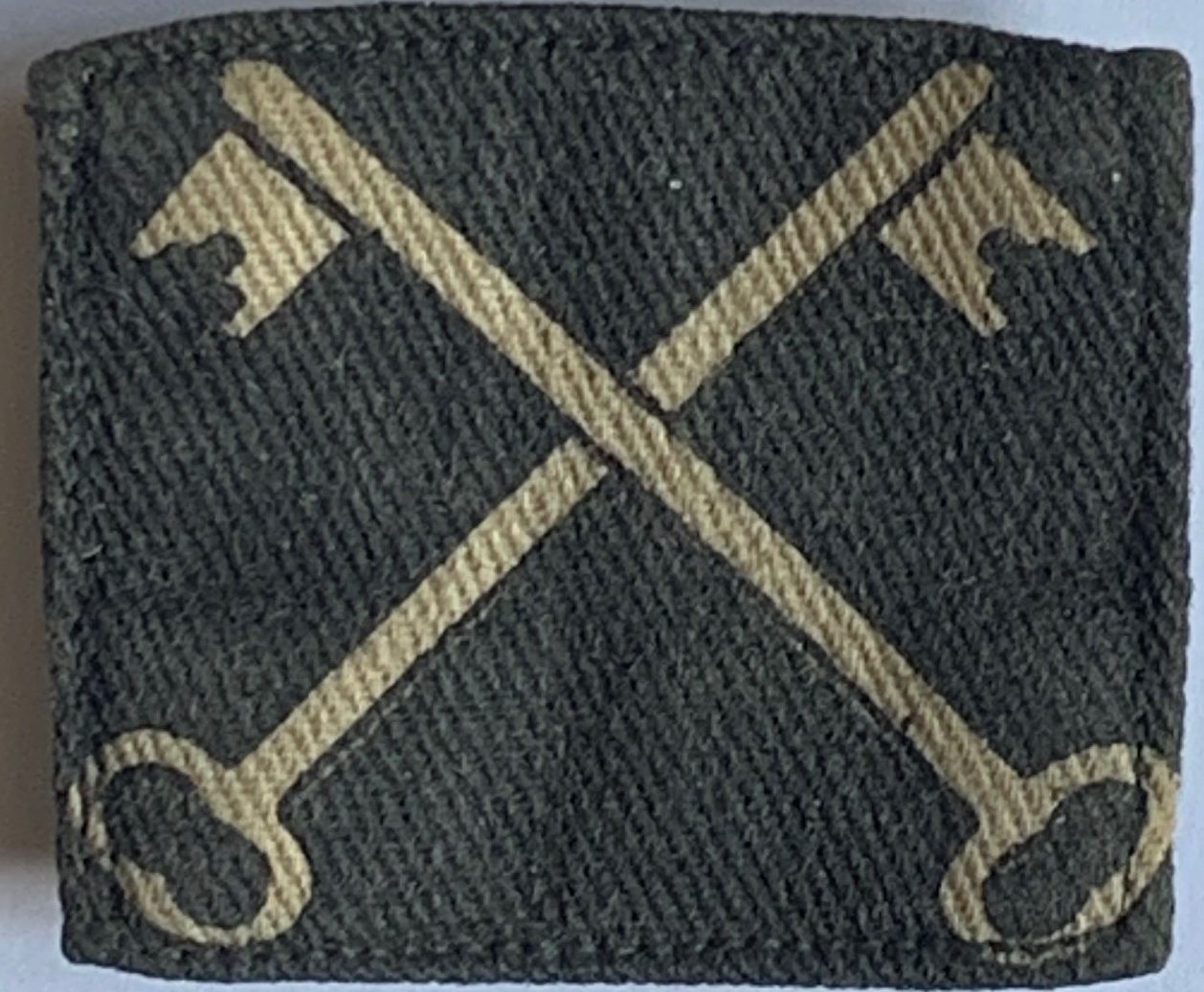
2 Dorsets Reach Tokyo
Once the shock and excitement of the sudden Japanese surrender had died down, the conversation in 2nd Division turned quickly to wondering what next? Would those due for repatriation be home in time for Christmas, the first in Britain since 1941?
Corporal Tom Cattle of the 2nd Dorsets:
“I thought perhaps now I should get home. But I’d only done two years, whereas the rest of the Division, who’d gone out in 1942, were now coming up to their three years. At that time you had to serve abroad three years before you came home. They decided that they would now repatriate the men of the 2nd Division who had gone out in 1942. And this they did. The battalion split up. The people come out in ‘42 were sent back home & the Dorsets & Camerons & Worcesters of 5th Brigade were now going to take in reinforcements. They were going to make a Brigade of British troops to go to Japan on occupation duties!” (29)

1 QOCH CO AJJ Somerville McAlester
To make the Brigade more representative of the United Kingdom, 2nd Royal Welch Fusiliers were transferred across from 36th British Division. They replaced the 7th Worcesters, a Territorial battalion that was sent home. This left 5th Brigade with an English, a Welsh & a Scottish battalion.
On 15th September 1945, 2nd Dorsets CO published a Special Order of the Day stating:
After six years of war & campaigning in Europe & Asia the 2nd Bn The Dorsetshire Regiment has been reformed for special duties. Those who now leave the Battalion depart home … with the feeling of a great job well accomplished & in going you take my earnest thanks & very best wishes for the future. To those who remain & to our reinforcements, I would say that we have a very great task to perform. ‘On, on, 2 Dorset.’ (30)
Loss of those repatriated left the battalions severely depleted. To make up numbers, the 2nd Dorsets received 136 men from the 7th Worcesters & 400 from the 10th Glosters of 36th Division. By December, only four officers & 38 other ranks remained who had fought with the Battalion in Burma. To help unify the disparate parts, the CO instigated a rigorous regime of parade drill & raised a Corps of Drums.

Amongst the Dorset’s intake from the 7th Worcesters was Lieutenant Ralph Norris. Ralph had fought with the 1st Royal Berkshires throughout the Burma Campaign & then was sent for officer training at the Indian Military Academy near Delhi. On graduating in May 1945, he was commissioned into the 7th Worcesters, but transferred in September to the 2nd Dorsets. He wrote to his parents on September 15:
“I like this battalion very much & I feel quite at home in it as all the Division’s battalions have similar traditions. We are not nearly up to strength, but we’ll be reinforced in a few days’ time and then there’ll be a lot of reorganisation work to do.” (31)

To his girlfriend he wrote:
“The army is returning to pre-war style & the Divisional Commander in a talk the other day pronounced “I believe in spit & polish”. When I hear that sort of thing, I feel like deserting…
We are forming a brigade for a very special job. I cannot tell you what the job will be, but these three battalions will be the most highly honoured in the British Army. It’s wonderful to come back to this Division & it’s as good as it ever was.” (31)
But on 6 January 1946, Ralph’s letter complained:
“Tomorrow I’m instructing on a tactical course. Another little job which has been handed out today is that of carrying the Regimental Colour on parade. I never seem to be able to persuade the Army that my whole self revolts against being smart & excelling in drill!” (31)

The British Commonwealth Occupation Force (BCOF) contained Australian & New Zealand brigades, as well as a Division, known as BRINDIV or BRINJAP, containing the 5th British Brigade (1st Camerons, 2nd Dorsets & 2nd Royal Welsh Fusiliers) & the 268th Indian Brigade (5/1 Punjab, 1/5 Mahrattas & 2/5 Gurkha Rifles). BRINDIV was commanded by Maj General ‘Punch’ Cowan, who had led 17th Indian Division magnificently during the Burma Campaign.

The first battalion of 5th Brigade to set sail for Japan was the Camerons, who arrived at Kure on 4 April 1946. According to Lt Col ‘Knocker’ White, CO of 2 Dorsets, their priority was because they
“…were in a better position to make the most appropriate martial noises on landing, being fully equipped with bagpipes.” (30)

The next day, the Dorsets sailed
“… with the Corps of Drums playing us out of Bombay harbour, past the Gateway of India, & we saw for ourselves what for many people is the best sight in the world – Bombay from the stern of a steamer moving out to sea!” (30)

As they approached the “very battered harbour of Kure, Japan’s greatest naval centre”, Lt Col White reflected that
“Nowhere have I seen such a naturally impregnable defence line as that presented by the island-studied rocky coast of Japan. Every island was a potential bunker, & the Creator, in an outburst of tactical enthusiasm, must have designed each island to be mutually supporting, standing out as sentry posts before the even more formidable coastlines of the larger islands. No; whatever else one may feel about the atom bomb & its potential horrors, we all felt as we approached Nippon, that the timely destruction of two Japanese cities saved at least a million Allied casualties.” (30)

They disembarked on 24 April “in the pouring rain, which deprived us of our chance of marching ashore with drums beating & colours flying – a ceremonial to which we had given much time & effort in the way of drills & rehearsals during the voyage.” (30)
Corporal Cattle described the condition of the people he first saw as
“Terrible. It was really horrible to see them. They were so cowed & frightened. They were all trying to get clothes & blankets. They’d obviously lost everything. Everything.” (29)

Initially, the Dorsets were based about a hundred miles from Kure at Honshu, which Corporal Cattle considered “quite a nice small town.” They were happy to meet there a Wasbie detachment, who established a canteen. Some of these women had campaigned with 2nd Division in 1944.

The Dorsets were billeted in barracks built for the Japanese Army, which Lt Norris considered “much more pleasant than any barracks I’ve seen in England.” (31) Furthermore, the natives “greeted us with extreme courtesy & even friendliness.” (30) Things were looking up.
Every day, little paper bags of bones would arrive at the railway station to be met by the next-of-kin & taken to a burial ground.
The people of Matsue were ordered to attend a victory parade on the second anniversary of the Battle of Kohima, which Lt Col White considered to be May 13. The town’s Chief of Police issued instructions that
“City people should show their hearty welcome & be careful not to fail to salute the Regimental Flag & Commanding Officer.” (30)

Corporal Cattle:
“CO decided that on the 13th of May he was going to have a big parade to show the victorious army. He had horses for him & his adjutant & there were carriers right in front of the band & the band was playing & we marched through with colors flying. The whole battalion & the whole of the town were ordered to turn out to see this parade & it was quite something.” (29)
They formed up in the square, with pride of place given to the W.A.S.(B.) & the two dozen Dorests who had fought at Kohima (most of the survivors having been repatriated). Lt. Col. White then gave a speech describing the “annihilation” of the Japanese 31st Division. He observed that
“The large number of Japanese present listened attentively, but, from their polite applause … I gathered that not much of what I had been saying had sunk in.” (30)
Afterwards, the veterans had a reunion & their picture taken.

After three pleasant weeks in Matsue, the Dorsets relocated to Gomen on the island of Shikoku in the Inland Sea. Their base had previously been a training centre for kamikaze pilots, but their role was more pacific. It was described in a postwar interview with Tom Cattle:
“We were back to peacetime soldiering now. There was a lot of black market going on that we were supposed to be stopping. They were so short & desperate for everything. They were in very poor state. There was a lot of people coming in from Korea, I think it was, into Japan as well. They wanted to stop illegal immigration into Japan. But the main thing was discovering where the ammunition dumps were & getting them destroyed.” (29)
INTERVIEWER: Did you ever find any arms or ammunition? Oh yes. Quite a lot, quite a lot. (29)
INTERVIEWER: How did the troops get on with the Japanese population? “Well, it was very difficult really, because the men folk didn’t take to the occupation troops at all. But the ladies were a different kettle of fish. They & the children. The thing that stood out most in my mind was the friendliness of the children. They would help & try to speak the language.


Although I wanted to get home, it was quite an interesting six months as far as I was concerned. I didn’t know anything really about the Japanese culture at all, except that we had to kill them in Burma. That was our main outlook in life, to get rid of them. But the country of Japan was beautiful. It was a lovely country when you got out in the countryside. I wouldn’t say the towns, because the towns are like every town. They’re crowded & hustle & bustle. Whereas out in the country, these are the true Japanese people I think. They were so friendly, you know. They would take you into their homes & you could talk to them. But it was very difficult, because the language was so difficult, although they gave us books & what have you, it was very difficult to pick up the language. (29)

Then they moved to Tokyo, because 2 Dorsets had been chosen to be the B.C.O.F. guard battalion, a singular distinction.
“They decided that the Dorsets should go to Tokyo & do occupational duties in conjunction with the Americans. So it wasn’t long before we found ourselves in Tokyo. To start with we went to a place that had been bombed. It was a horrible billet, but we didn’t stay there very long. We were moving on again into the center of Tokyo, where we were billeted with Americans & attached to them. We were living like Lords. We were dining in lovely places. Bands were playing while we were dining. We were sharing duties with the Americans. it was quite an experience. I was there for six months.” (29)
Ralph Norris was more reflective. On 18 June he wrote to his girlfriend:
“It amazes me that the Japanese are so cheerful. The facts of the situation would seem to make cheerfulness impossible. Families have been broken up to a degree far beyond what has happened in our own country; thousands upon thousands of soldiers are still missing. Hundreds of thousands of homes have been wiped out by bombs; disease is spreading & the population is on the brink of starvation; for example, 34,000 people have died of starvation in Tokyo since November. I’m not inclined to be very sympathetic, because it is part of the cost of waging an unsuccessful war, but it is always the common people who suffer from wars, who are only very indirectly responsible themselves.” (31)

Lt Norris was made Guard Commander of the Imperial Palace. His CO was impressed:
“The Imperial Palace guard was the most interesting & the hardest, as there was no relaxation.

Out of the 11 posts around the Imperial Palace, five were shared with an American sentry. Each sentry did his own drill & went his own way. I cannot speak too highly of our sentries who, throughout those seven long weeks, maintained the high standard of drill & alertness that we expected of them. It is not easy to remain smart & soldierlike when your companion on the post allows himself a rather more relaxed form of stand-at-ease.

The ceremonial guard rapidly turned into a most popular spectacle, if one can judge by the mass of Servicemen & women of all nations who used to watch it.” (30)
On 28 June, the Dorsets had the distinction of Trooping the Colour on the plaza of the Imperial Palace, with eight Generals in attendance.

Tom Cattle was thrilled:
“We Trooped the Colour on the Plaza of the of the Imperial Palace, which was quite something. We had the colors there & all the dignitaries, all the American Generals. My goodness that was quite something to take part in.” (29)

Lt Norris tried to sound blasé when he wrote to his parents:
“Only eight Generals were in attendance. I think we rather dazzled the Americans with our performance.” (31)

He was right. General Eichelberger, Commander 8th U.S. Army, wrote to Lt Col White:
“Not only was the ceremony beautiful, but its execution was the most exact I have ever seen, & you know I have seen troops all over the world. It was very impressive indeed & I congratulate the Dorsets.” (30)

This made White feel “prouder than ever. This latest generation of Dorset soldiers were more than upholding the tradition of the Regiment.” (30)
The 2nd Dorsets were in Tokyo from 12 June to 22 July 1946 & then returned to Gomen. They remained there until February 1947, but many of their number were allowed home sooner, having served the requisite duration overseas. These included Lt Ralph Norris & Tom Cattle, who was now a Lance Sergeant:
“By this time, I’d been abroad for three years & so they thought they’d better send me home. So I came back home, thank goodness, safe & sound.” (29)

They boarded the SS Mataroa at Kure on 18 September & disembarked at Southampton on 24 October 1946. The following day was Ralph Norris’s 23rd birthday.
The Kohima Museum thanks Mark Norris for sharing the unpublished wartime story of his father Ralph W. Norris, based on his diaries.

A Cameron Highlander in Japan
Frank Perkins was conscripted near the end of WW2. Although he had been living in London, he was attached to the Gordon Highlanders & received most of his initial six months training in Scotland. He was then shipped to Bombay.

After disembarking, he was bundled into a truck which took him to a transit camp. There he received inoculations, graphic lectures about clean living, & drills in anti-malarial practices. Then he was assigned to the 1st Battalion Queen’s Own Cameron Highlanders.
Many of the battalion had fallen during the Burma Campaign & a large proportion of the survivors had been repatriated. The remnants were based near the city of Nasik, about 100 miles from Bombay. A lot of them were just waiting for their turn to go home & some were drinking heavily. They weren’t interested in the new arrivals.

They were housed in ragged, dusty tents & slept in dilapidated beds crawling with lice.
Drinking water was stored in large canvas bags shaped like cauldrons, kept cool by evaporation. It was so chlorinated that Frank thought it was like drinking pure bleach.

The bread was loaded with weevils. It was fried for breakfast & served with porridge. Later in the day, it was spread with runny margarine & sometimes jam. These delights were generally supplemented with American ‘K Rations’, which were survival packs intended for combat conditions. They contained a can labelled ham & egg, hard tack biscuits, brittle chocolate, pieces of toilet paper, cigarettes & matches. From time to time, meals were enlivened by buzzards swooping under the canvas to snatch whatever was available, even from their hands.
As the battalion kicked its heels in the Indian plains, morale ebbed & tempers frayed. Someone cut the guy ropes of the sergeants’ mess marquee, throwing its flailing occupants into a bellowing fury. The new RSM was attacked in his tent while sleeping. There were suicides.
Eventually the battalion reached full strength & was informed that it would be part of the British Commonwealth Occupation Force (BCOF) in Japan. This contained British, Indian, Australian, & New Zealand Brigade Groups, as well as air force & naval contingents from these countries.

The British India Division (BRINDIV) included 5th Infantry Brigade Group, which had one English, one Welsh & one Scottish infantry battalion: 2nd Dorsets, 2nd Royal Welch Fusiliers, & 1st Queen’s Own Cameron Highlanders.
The Dorsets acquired a fine band & the Royal Welch Fusiliers found a goat to serve as their traditional mascot. The Camerons received full Highland dress uniforms & pipers. The assembled brigade was now an impressive sight.

After several weeks of drill practice, they broke camp & set sail. En route, they stopped for a parade in full dress through the heart of Singapore. Taking the salute at the Municipal Building was Admiral Lord Louis Mountbatten himself, Supreme Allied Commander South East Asia. Protocol satisfied, they sweltered back to the ship.

At Hong Kong, there was a similar performance at the dockside, but nobody was there to see it.
The initial headquarters of BCOF was the port of Kure, near Hiroshima. It had been the principal naval base of Imperial Japan & included the largest combined dockyard, ship-building yard & naval arsenal in the country. Arriving in March 1946, Perkins watched apprehensively as his ship approached Kure harbour. The shores rose steeply from the sea, into hills bristling with gun emplacements. He reflected that taking Japan by conventional assault “would have cost an incalculable number of lives over an inestimable period.”

They set up station at Hiro, about 15 miles from Hiroshima, replacing an Australian unit. The locals were reluctant to make friends, which came as no surprise. In an exchange of opinions with a young, well-educated Japanese ex-serviceman, Perkins was told in excellent English that many Japanese did not consider the conflict ended. Moreover, he claimed they had facilities to continue. The whole of the BCOF area was found to be honeycombed with caves & tunnels. Many contained large quantities of explosives, ammunition & poison gases.
Most of the landscape was mountainous. Everywhere was farmed on terraces, with rice the main produce. Paddy fields in the few flat areas came alive at night with incessant croaking of frogs.
Inflation was out of control, with prices doubling every day. The old Japanese currency was recalled & a new currency issued.
Eventually, 5th Brigade handed the station at Hiro back to the Australians & moved to Shikoku, a large island in the south of Japan.

The Dorsets were sent to Tokushima in the northwest, the Royal Welch were stationed at Matsuyama in the east & the Camerons occupied a former Japanese barracks outside the city of Kochi on the mid-western coastline of the island. This barracks was built around a massive parade ground & consisted of single storey buildings built entirely of timber & with their floors raised three feet from the ground on stilts. The electricity supply was laughable: two lines of bare copper wire supported on insulators running the entire length of each building; connection for any appliance was made using crocodile clips.
Many barrack rooms had an insignificant trapdoor in the floor. Tucked away underneath were cases of well-preserved weapons & ammunition. This provided a sharp reminder to stay vigilant & sparked a diligent search.

On December 21st 1946, Perkins was woken by the noise of an approaching gale. The building began to shake & he scrambled from his trembling bed, but could not stay upright as the floor moved violently. He felt helpless, but the tremor subsided after four minutes, with the building still standing. He got dressed calmly. Then the noise & trembling resumed. Rushing outside, he found the movement even more violent, but it quickly abated.
After further tremors of varying strength, daylight revealed the extent of damage. A brick cookhouse built by the Camerons was reduced to rubble, but the wooden Japanese barracks were still standing. The shaking had dislodged a cache of grenades hidden in the rafters.
Security was immediately tightened. To reassert their authority, a company in full battle order with a piper & drummer & led by a Bren carrier marched into the accessible areas of Kochi in a show of strength.
The epicentre of the earthquake had been out at sea. It had created a tsunami with 20 foot waves that engulfed much of the city of Kochi. Large boats were left stranded miles inland & many people were washed out to sea.

About 1,400 lives were lost & 36,000 homes destroyed.

But no casualties were sustained by the Commonwealth force, whose bases were sheltered by hilly terrain.
Earth tremors continued for two weeks & the seawater took a long time to recede. It had not returned to the original coastline when the Camerons left Japan in early 1947.
The battalion marched out with great pomp & ceremony.

Frank Perkins was not amongst them. He had to supervise carriage of some crates to Kure & ensure they were loaded safely onto a ship. He did not know their contents, but suspected it might be ‘bounty’ collected by the CO. His attitude on leaving:
“From me, no goodbye, definitely no thank you, only a positive message. I will not be back!”
The above is a highly abridged version of “A Year in Japan, Post-Hiroshima: Cameron Highlanders as Occupation Force” by Frank Perkins. It is article A1143857 contributed in 2003 to the BBC WW2 People’s War archive. It can be accessed in full here.

March 4th to 9th 1946 was declared Victory Parade Week in Delhi to celebrate the defeat of the Axis Powers in WW2. The parade itself was held on March 7th & involved all arms of the Defence Services of India, as well as Delhi District Police & Allied Forces based in India during the war.

It began with a mechanized column that took about half an hour to pass & was led by General Sir Claude Auchinleck. This was followed by a marching column that took about three quarters of an hour to pass. The parade ended with a fly past by the Royal Air Force & the Royal Indian Air Force.


Elsewhere in Delhi, massive protests coincided with these celebrations. Shops, mills, trams, cinemas & schools were closed as a hartal (act of civil disobedience). Paper badges were distributed reading “Boycott Victory Week”. Protesters chanting anti-British slogans set fire to the Town Hall & the main station of the Fire Brigade. Police opened fire on a mob that gathered outside the Imperial Bank, causing several deaths.

Although Congress Party Leaders had supported the hartal, they tried unsuccessfully to calm the crowds when they became violent. The parade itself was not molested, but isolated British & Americans were stoned, including an RAF Air Commodore & his wife returning to their hotel. By nightfall, police & British troops patrolled the troubled sectors of Delhi.
The term ‘comfort women’ is a euphemism for women used as sex slaves by the Imperial Japanese military. According to the Association for Asian Studies “It is the largest case of government-sponsored human trafficking and sexual slavery in modern history”. Lack of records make the numbers involved uncertain, but experts believe that hundreds of thousands of victims were enslaved for this purpose, including girls as young as twelve. The majority were from China & Korea, but some came from Japan & most, if not all, Japanese-occupied territories. Some victims testified that they had to serve up to sixty soldiers each day.

What follows is an abridged version of an article published by The Association for Asian Studies. The original can be found here.
“Comfort stations”, where these women were abused, were first established in Shanghai in 1932, then in Japan, China, the Philippines, Indonesia, Malaya, Siam, Burma, & wherever the Japanese military went.
Initially, they were filled with prostitutes from Japan who came voluntarily. However, as military expansion continued, the Japanese turned to local populations in occupied areas. They used local brokers to obtain women, particularly in Korea & Formosa (now Taiwan). The most common way to “recruit” young women in Korea was by making false promises of employment as factory workers, nurses, laundry workers, or kitchen staff in Japan or other Japanese-occupied territories. Typically, daughters of poor peasant families would be deceived in this way & only discover the nature of their work upon arrival at a comfort station. Once enough women had been gathered, they would be sent to China or other war zones. The police were also used to procure women.

There were detailed regulations for the operation of comfort stations. For example, these specified the medical examination of the women, the fees for soldiers & officers of different ranks, & mandatory use of condoms. However, condoms were sometimes unavailable & some soldiers refused to use them. In some cases, such as the Shanghai comfort station, the Japanese military forced women to receive an injection of Salvarsan to prevent syphilis, but it is toxic and caused infertility. The fees charged by the comfort stations went to the station staff & not the women.

The Japanese military justified the system in several ways: to boost morale; to control the behaviour of troops; to contain venereal diseases among the troops; to prevent rapes by Japanese soldiers, thereby avoiding resentment among inhabitants of occupied areas.

A former comfort woman, Yong Soo Lee testified before the US House of Representatives’ Foreign Relations Committee. Such testimony resulted in the nonbinding US House Resolution 121 (2007), urging Japan to accept full responsibility for the actions of its military.
Lee lived in Taegu, Korea, under Japanese occupation. Her family was poor & she received only one year of formal education. She began working in a factory to support her family at the age of thirteen. In the autumn of 1944, when she was sixteen, she & a friend were taken to Taiwan, where they were forced to work as sex slaves for the Japanese military. A Japanese man came to her home & called her to come out. Without knowing where she was going or why, she was taken away by Japanese soldiers & put on a train with three other girls. During the journey, the soldiers raped. hit & kicked them, & she sometimes lost consciousness. Via Shanghai, they ended up in Taiwan. At the comfort station there, Lee had to serve four or five men a day. She was never paid for these services. As well as being raped, she was beaten & tortured. They were warned that if they tried to venture beyond the confines of the station, they would be killed. She was too frightened to think of escape & she did not know where she was. Lee was eventually captured by the Allies & put in a POW camp, before being sent home. When her mother saw her, she thought Lee was a ghost & fainted.

In addition to her physical injuries, Lee suffered enduring psychological trauma & social stigma after her return to Korea, like many other survivors. She felt shame about her shattered childhood that haunted her throughout her life. She could not consider marriage after all she had endured. She could not tell her story to anyone for decades. Then, in 1992, she broke her silence & spoke about her experiences. She became a public figure & activist, pressing the Japanese government for official acknowledgments & apologies to the comfort women. She attended numerous international conferences, US congressional hearings & presented her testimony in Japan, China & Taiwan to raise public awareness.
In the Philippines, Hiralia Bustamante was kidnapped by Japanese soldiers on her way home after helping her mother pick rice. She was taken to a house & confined with two or three other women who were also kidnapped. They were forbidden to talk to each other & ordered to cook & clean during the day. Every night, they were raped by the Japanese soldiers. Anyone who tried to escape would be shot. The horror lasted several months.

Jan O’Herne was nineteen when the Dutch East Indies were conquered by the Japanese in 1942 & was interned with thousands of other Dutch people. One day in 1944, high-ranking Japanese officers arrived at the camp & ordered all single girls of 17 years or older to line up. They paced along the line, eyeing the women up & down, & selected 10 pretty ones, including Jan O’Herne. The whole camp protested & the girls’ mothers tried to pull the girls back. O’Herne embraced her mother, not knowing if she was ever going to see her again. The girls were thrown into an army truck & taken to a brothel in Semarang. They were “systematically beaten & raped day and night,” O’Herne said. “They had stripped me of everything. They had taken everything away from me, my youth, my self-esteem, my dignity, my freedom, my possessions, and my family.” After three months. she was returned to prison camp with threats that her family would be killed if she revealed what had happened.
While testifying to the US Congress, O’Herne said that “the war never ended for the comfort women.” She decided to break her silence to back up the other survivors & prevent similar crimes against women. She testified as a witness at the international public hearing on Japanese war crimes in Tokyo in 1992.

A comfort women memorial was unveiled in San Francisco in 2017. This bronze statue presents three teenage girls, representing China, Korea & the Philippines, standing in a circle, holding hands. Next to them is an elderly woman figure in Korean dress, looking at the young girls. The inscription starts with a former comfort woman’s remark: “Our worst fear is that our painful history during World War II will be forgotten.”
There are many eyewitness accounts of Japanese Zero fighter aircraft appearing during the Battles of Imphal & Kohima. For example, Captain Harry Swinson of 7th Worcesters described an attack at Kohima on May 5th by four low-flying Zeros that …
“… swept down the valley through the flak that was already filling the sky, to strafe Div HQ & the forward gun positions. A quick wheel before Kohima Ridge & they came roaring down on us, their cannons blazing. The flak by this time was thicker than ever, but the Zeros seemed equipped with immortality. Ten seconds & they were on us, so low that I felt I could reach up & pluck them out of the sky.” (17)

These reports are all mistaken, as the Zero was not used by the Japanese army, only by the navy. The aircraft that was habitually mistaken for a Mitsubishi Zero was the Nakajima Oscar.

American pilots often referred to the Oscar as the “Army Zero”, but they had different designs & manufacturers.

Like the Zero, the Oscar was designed with maneuverability as a priority. Indeed, it outperformed the Zero in this regard & was affectionately referred to as the “dogfighters delight” by its pilots. However, the iconic Zero had longer range, heavier armament & was far more famous.
2025 was a wonderful year for the Kohima Museum. Visitor numbers doubled. The Museum’s website & social media sites flourished, raising awareness of the Burma Campaign far beyond our shores. The team of volunteers who run the Museum has grown & we have two new trustees. We won our first competitive grant & held our first exhibition.
The Museum in 2025 benefitted from two curators, with complementary skill sets: Bob Cook (curator since 2008) & Bob White (who joined in 2023). BobW wrote this account.

We began the year missing Brian Ward, an invaluable member of the team for 12 years, who had left us on reaching his 80th Birthday in 2024. But we were glad to recruit three new assistants: James Heathfield, Luke Usher & Jana Jurgova, all of whom have Masters degrees in history. Thanks to this extra cover, we never in 2025 needed to close due to holidays or illness.

The Museum was also fortunate to recruit two new members to its Board of Trustees. The first was Simon Sole, whose father fought in the Battle of Imphal, & the second was Jerry Bird, whose uncle was killed in the Battle of Kohima. They both have some great ideas for the Museum.
In February, I delivered a webinar called “Treasures of the Kohima Museum”. It was part of the excellent webinar programme produced by Kohima Educational Trust. In my webinar, I described the history of Kohima Museum & some of the objects in its collection. This webinar can still be watched by clicking here. To date, it has been watched 946 times, a powerful way to promote the Museum.

In March, I made my first visit to Kohima, combining it with a stay in Jessami. After the Battle of Jessami in 1944, the survivors of 1st Assam Regt marched 78 miles through the Naga Hills in 39 hours to reach Kohima before the Japanese, where they were pivotal to the Garrison’s defense.

Sampan Travel organize a fabulous tour that includes this epic march, in addition to guided exploration of the Jessami & Kohima battlefields. The tour guide is Charlotte Carty, granddaughter of Lt Col Brown, 1st Assam’s commander during these battles. She has researched the history in great depth & brings it alive with her vivid, insightful guidance.

I decided to attempt this trek. Once committed, I trained obsessively throughout the winter months. Apart from the challenge of walking so far, I was concerned that the hills would injure my elderly legs. In addition, I had no idea how I would cope with the sleep deprivation: like the original march, we would set off at midnight on April 1/2 & walk through two consecutive nights. To prepare for these challenges, I took night walks over various Yorkshire hills, gradually building the distance & duration. In March, I walked up & down a suitable hill for 15 hours, beginning at midnight, & then repeated the exercise nine hours later. Locals found this behavior eccentric.

On reaching Nagaland, we explored the battlefields of Jessami and Kharasom, where the Assam Regiment had its baptism of fire in 1944.

The walk itself was unforgettable – extremely challenging but also often fun, due to the tremendous spirit of camaraderie that quickly developed amongst the six walkers, local guides & support team that welcomed, encouraged & fed us at the 19 checkpoints en route. Witnessing dawn in the Naga Hills after walking through the night was moving. The organization was superb throughout, as were the regular, plentiful & delicious meals.

Each walker was accompanied by a Naga guide, in his early twenties. In 2024, none of these young bucks managed to stay the course, so in 2025 they doubled up, alternating between walking a section & sleeping in a support car, whilst their elders plodded on. Every hour my guide would ask “Are you okay sir?” After reassuring him, I invited him to call me Bob. I was amused an hour later by the question “Are you okay Sir Bob?”

Tents were available at a checkpoint reached after walking for 22 hours & covering 54 miles. I lay down for an hour, but could not sleep. I was surprised how much harder the ground has become since I was young. At midnight, we were off again.

Three of our number fell by the wayside, through exhaustion, injury or illness. There was a scare when Charlotte began falling behind; would we lose our leader? As I panted to the top of a long, steep hill, after miles of switchback to lesson the gradient, I worried about how far behind she might be. Suddenly, she appeared before me, dusty & breathless! With her guide, she had scrambled straight up the cliff, short-cutting miles of road. It was a glorious surprise. I marveled at her fortitude.

We stuck together for the last few miles. It felt great to sit down at the finish, knowing that the clock was no longer ticking down to another restart for the next stage.

Visiting Kohima War Cemetery was the most important part of my trip. A place for quiet reflection.

A visitor to Kohima Museum had asked me to plant a cross with a message by the grave of his grandfather Charles Hunter of the Royal Scots. It was a privilege to do this.

There is an excellent “2nd World War Museum” at Kohima, focused entirely on the battle there in 1944. It contains many artefacts & displays & is well worth a visit.

Back in York, there was great excitement when the Museum was offered on loan the Victoria Cross awarded posthumously to Captain John Randle, for his heroic attack on GPT Ridge during the Battle of Kohima. This inspired a summer exhibition “Victoria Crosses of the Burma Campaign.”, which described the heroic events leading to the award of twenty of these famous medals. Much to our delight, Brian Ward came out of retirement to help prepare the exhibition.

Our VC exhibition received hundreds of visitors, including the Minister Plenipotentiary of the Japanese Embassy, who described his visit as “an invaluable experience”.

Kohima Museum won its first competitive grant. We were awarded £8,000 from Arts Council England & Museum Development North to fund events to mark the 80th Anniversary of Victory Over Japan. We repurposed our VC Exhibition as an event to mark VJ80, so that we could use some of the grant to pay for alterations to the Museum’s displays & for flyers, posters & a banner to advertise the event.

The grant also paid for renovation & framing of a unique flag captured from the Indian National Army by Captain John Randle & generously gifted to the Kohima Museum by his son.

On August 15, VJ80 day, we set up a stand at York Army Museum, with bunting & posters detailing the Japanese surrender. We are very grateful to Graeme Green, Curator of York Army Museum, for his support in this. His excellent Museum is located in the centre of York, providing far higher visibility than we have at our location inside Imphal Barracks. To increase interest, we recruited living history group ‘Take Your Mepacrine’, whose expenses were paid by the grant.

The following day, I took the Kohima Museum road show to a large VJ80 event at Bankfield Museum, Halifax, home of The Duke of Wellington’s Regiment Museum. Their celebration involved military vehicles, reenactors, food stalls, period music & dancing. It was great fun & enabled me to showcase the Kohima Museum to large numbers of people, some of whom subsequently visited us in York.

To promote inclusivity, our grant paid to hire a coach that took thirty economically disadvantaged children & parents from York to the free event at Bankfield, which they enjoyed tremendously. These families were recruited by a local charity.

The grant also funded the travel & accommodation for one of our new volunteers, Luke Usher, to attend the Curator Course at the National Army Museum. He appreciated this very much.

The Burma Campaign Society (BCS) was established in 2002 to promote understanding of Britain & Japan’s conflict during the Second World War.

To mark VJ80, BCS organised a visit to the UK by ten Japanese whose fathers, grandfathers or great grandfathers once fought against the British. The purpose of their visit was to extend to the UK their work of “irei” – a Japanese word which means to console the spirits of the fallen; to pray for the repose of the souls of those who made the ultimate sacrifice in war.

On August 13, they laid a wreath at the Kohima Memorial beside York Minster. We were then delighted to welcome them at the Kohima Museum. Takuya Imasato said he wanted his child to experience how the war is interpreted & commemorated in Britain. Yoshiko Fujiwara reflected “We cannot change what happened, but we can listen, remember, & share. If my father fought in the atrocious conditions of Burma, perhaps our task is to fight against forgetting & to pay respect to those sacrificed. Now, as his descendants, we feel it is our duty to tell the story – not to glorify, nor to be ashamed, but to understand & have dialogues.”

On August 15, the BCS group attended the national commemorative ceremony ‘Remembering VJ Day 80 Years On’ at the National Memorial Arboretum in Staffordshire. They paid their respects & forged connections with surviving British veterans & descendants of the fallen in Burma. An excellent article in The Conversation by Kyoko Murakami. The full article can be read here.

Chairperson of BCS, Mrs Akiko MacDonald, who lives in the UK, said she was delighted with how the visit went. “My father survived, but in his post-war years, he suffered from survivor’s guilt & PTSD. In postwar Japan, if one returns home alive, he is not a war hero & is made to feel ashamed.”

The Kohima Museum curatorial team were honoured to be invited in December to the Japanese Embassy for an award ceremony in which Akiko MacDonald received the Japanese Foreign Minister’s Commendation for her decades of work fostering reconciliation and friendship between the UK and Japan. The Award was presented by The Ambassador of Japan, Mr Hiroshi Suzuki. It was a joyful occasion.
A new picture of General Slim raising the Union Jack at the victory parade at Mandalay was created by artist/historian Tim Godden. It was commissioned by Giles Usher, who generously gifted the picture to the Kohima Museum.


The website is our most effective medium for widening awareness. In 2025, the Kohima Museum website was visited almost 20,000 times, averaging 54 visits each day. This was a 34% increase over 2024. About half of these visits came from outside the UK (48%), demonstrating the global reach of the internet. The next most common homes of website visitors were the USA (22%) & then India (6%), followed by locations throughout the world. It is great to attract interest in the Burma Campaign so far afield.
Several new pages were added in 2025, to broaden coverage of the Burma Campaign. These included a page about the Battle of Sangshak & a page describing some of the extraordinary personalities involved in the Battle of Kohima, such as The Deputy Commissioner Charles Pawsey. Another describes some of the Victoria Crosses won in the Burma Campaign, to coincide with the exhibition. I aim to keep adding to the website. There is so much material to share.
Kohima Museum has 4,059 followers on Facebook, a 13% increase on last year. They are very cosmopolitan, with 52% outside the UK, including 37% in India & 5% in the USA. Our UK followers are dispersed throughout the nation; York has the highest concentration (7%) followed by London (5%). In contrast, our large Indian following is highly localized to Nagaland & Manipur, with the highest concentrations of our followers in Kohima (35%), Dimapur (22%) & Imphal (14%). Delhi has 6%. The Japanese invasion of India is not taught in Indian schools, even in Nagaland, so it is valuable for us to raise awareness about this important event in Indian history.

Facebook provides information about the demographics of the Museum’s followers. 26% are 65 or older & 19% are younger than 35. However, only 2% are younger than 25, which is a worry. We must engage the younger generation(s), to ensure that interest in the Burma Campaign is passed on. It is lamentable that the school curriculum does not include this episode in our history, where 30,000 British lost their lives.

Last year I set up an Instagram account for Kohima Museum, as Instagram is popular amongst youngsters. It had 116 followers at the end of 2024 & reached 393 by the end of 2025, a 3.4-fold increase. I hope this rapid growth will continue, so please follow @kohima.museum if you use Instagram.

I organised four visits by groups from the two universities in York, bringing 58 students to the Kohima Museum. We also hosted two visits from groups of youngsters who were considering army careers, as part of Army Officer Insight Days organised by Imphal Barracks. Between them, these events brought in 174 young people, most of whom had no prior knowledge about the Battle of Kohima. We were delighted to have these opportunities to reach out to the younger generation.

Imphal Barracks provides tremendous support to the Kohima Museum, for which we are extremely grateful. The Garrison Commander, Lt Col Skinner, is an ex officio member of the Museum’s Board of Trustees & has been exceptionally helpful.

The total number of visitors to Kohima Museum reached 945 in 2025, almost double the total in 2024. We also engaged with 142 members of the public when we took our stand to Bankfield & York Army Museums. We are delighted with this success. VJ80 was undoubtedly a contributary factor. It will be difficult to match these numbers in 2026.
We are always especially pleased to welcome Armed Forces veterans & their families. A steady stream of wonderful Burma Campaign artefacts continues to be donated, some of which can be seen by clicking this link. It is a privilege & a pleasure to hear recollections about the men who fought in Burma.

Within the Ministry of Defence, the Office for Veterans’ Affairs (OVA) leads efforts to ensure that our veterans get the respect, support & recognition they deserve. In October, the OVA held a development day at Imphal Barracks & groups of them visited the Museum to hear Bob Cook & I recount the story of the Battle of Kohima. A few days later, the Director wrote to thank us. With her permission, I’ve included her letter below, as it is something that we are proud of. She wrote that “The museum itself is a remarkable space, and your wealth of knowledge, combined with the pride and passion you bring to sharing it, left a lasting impression on us. It served as a powerful reminder of the importance of remembering those who served and the sacrifices they made on our behalf.” I cannot think of a better commendation for the Kohima Museum.

The Kohima Museum is a registered charity, which relies heavily on the generosity of the public. We sincerely thank all who have supported us.
Donations can be made by bank transfer & will be gratefully received. Sort Code 08-92-99 a/c number 67337949.

On a dull day in November 1945, six thousand men of 2nd British Infantry Division arrived in Southampton aboard the troopships SS Strathmore & SS Winchester Castle, commandeered ocean liners.


A brass band added to the celebration.

Maj. General Grover, who commanded 2nd Division at Kohima, was waiting at Southampton to greet his former Division. When the troops spotted him, a chant of “Grover, Grover, Grover” arose.

Eventually, he stepped forward & made a short speech to welcome his men home, which was met by resounding cheers.

It was reported in Decko!, the magazine of the Burma Star Association, that the Captain of Strathmore became concerned that his ship would become unbalanced as all the troops crowded to one side.

The troops were not allowed to disembark until the following morning. This may have been due to administrative and/or logistical bottlenecks caused by port congestion, as they had to pass through dedicated disembarkation units & dispersal units.


It was worth the wait. When they were eventually allowed off the ships next day, some of the men were greeted by their loved ones.

On 12 September 1945, the official unconditional surrender of all Japanese forces in South East Asia was signed by General Itagaki in the Municipal Buildings in Singapore.
On the same day, General Ichida Jiro, Acting Chief of Staff of Japan’s Burma Area Army, formally surrendered to Brigadier E.F.E. Armstrong (Chief of Staff to Lieutenant-General Sir Montague Stopford, General Officer Commanding of the British Twelfth Army) at Government House, Rangoon

On 24 October 1945, a formal surrender ceremony, or handing-over of swords, was held by Rangoon University’s Convocation Hall. It was watched by crowds of British troops.

A Guard of Honour was provided by 1st Battalion Royal Berkshire Regiment of the 2nd British Infantry Division.

General Heitarō Kimura, Commander of Japan’s Burma Area Army, surrendered his sword to Brigadier E.F.E. Armstrong, who then presented it to General Stopford, Commander of the British Twelfth Army.
General Kimura would later be charged with war crimes, sentenced to death, and executed by hanging in Tokyo.
Successive Japanese generals then surrendered their swords to their opposite in command. Lieutenant-General Shozo Sakurai, commander of the Japanese 28th Army, surrendered his sword to Brigadier J.D. Shapland (commander of the Twelfth Army’s Royal Artillery).

The sword surrendered by Lt General Sakurai is now displayed at the Kohima Museum.

General Sakurai stayed on in a prisoner camp in Burma after the war, only willing to leave when all his men could return as well. He was repatriated to Japan a couple of years later and lived to the age of 96.
On 16 September 1945, Rear Admiral CHJ Harcourt accepted the unconditional surrender of all Japanese forces in Hong Kong.

The document was signed on behalf of the Japanese by Vice Admiral Ruitaka Fujita.

The ceremony took place at Government House, Hong Kong, with the Guard of Honour provided by men of the British Pacific Fleet.

On 15th June 1945, a victory parade was held in Rangoon to celebrate the defeat of the Japanese armies in Burma.

Admiral Lord Louis Mountbatten, Supreme Allied Commander, South East Asia, read an address to the assembled troops from His Majesty The King George VI.

The address was followed by a march past.


Mr Ray Grout contacted the Kohima Museum about an interesting map taken from a Japanese officer during the Battle of Kohima by his father Gunner Thomas Grout RA.

The map is noteworthy because it is a British map of the Naga Hills that has been copied & printed with Japanese annotations.


When Thomas Grout died in 1979, his wife received a letter of condolence from his former CO, saying that they had served together “for virtually the whole of the 1939-45 War, including active service in India & Burma & the epic Battle of Kohima.”

“He was an exemplary soldier in every way & was probably one of our best shots with a .303 rifle – he also used a Tommy Gun expertly when he acted as my personal bodyguard in the jungle.”

Thank you Ray for sharing these precious memories of your father.
Three staff, all unpaid volunteers, have worked at the Kohima Museum in 2024: Bob Cook (curator since 2008), Brian Ward (since 2012) & Bob White (since 2023). The team is pictured below in a C47 transport plane, which can be visited at the excellent Yorkshire Air Museum at Elvington, just outside York. Visitors can go inside the cargo hold & look into the pilot’s cabin.

The team were kindly invited to a Military Memorabilia event at the outstanding York Army Museum. We had the opportunity to tell many of the visitors about the Museum. It was disappointing to discover that most of those we spoke to had never heard of the Battle of Kohima, despite their evident interest in military history. There is clearly much work to be done to raise awareness of Kohima & the Burma Campaign. In contrast, we met a D-Day veteran who commented that the guys in Burma had it tougher than the heros of the Normandy Landings!

As a recent recruit, Bob White was sent on a five-day course for new curators at the National Army Museum in London. This included a visit to the Household Cavalry Museum.

Brian Ward has been an invaluable member of the team for 12 years, responsible for the immaculate presentation of the Museum. On his 80th birthday, Brian stepped back from this busy role. He was heard to mutter “One Bob’s bad enough”. His colleagues & the Museum’s Trustees are extremely grateful for all his tremendous work & hope that he will be a regular visitor.

A major effort has been made in 2024 to increase the Museum’s activity online. The website is our most effective medium for widening awareness, but it had stagnated in recent years.
To this end, the old pages were refreshed in 2024, with new images & content, & a range of new pages were built to broaden coverage. Pages have been added that describe the battles of Admin Box, Imphal, Jessami & Kharasom, as well as Air Power, Armour & the Naga. An Object of the Month page was introduced to describe some of the treasures of the Kohima Museum. A page about the Battle of Sangshak is being prepared for the New Year.
A Blog was introduced in March to coincide with the 80th Anniversary of the Battle of Kohima. New posts were added to this blog each day to describe events at Kohima on the corresponding date in 1944, from the crossing of the Chindwin by 31 Division to its miserable retreat along the ‘Road of Bones’. This material can now be read in its entirety at The Battle of Kohima – Day By Day. Daily coverage through the spring & summer was very demanding. The blog has since settled into a much more manageable routine of one new post each week, with ad hoc material about the Burma Campaign.
The effort has been rewarded by a substantial increase in traffic, with daily visits to the website increasing from 32 per day in February to 66 per day in November. Overall, the website has been visited more than 13,000 times since January 2024, taking the story of the Burma Campaign to a huge audience.
Activity has also increased on Kohima Museum’s Facebook page, which has 3,600 followers. A photo of curator Bob Cook at the Museum one Saturday morning received 374 likes, our new Facebook record. There’s no accounting for taste!

With the aim of reaching more youngsters, Kohima Museum opened an Instagram account. This is slowly building a following, but numbers are low so far (114 on December 31). Please follow us if you use Instagram.
It is hoped that social media activity will increase footfall to the Museum. Indeed, vistor numbers rose in 2024. This increase was also assisted by a banner to advertise the our existance to passers by & local traffic. It was the first time such an advertisement has appeared on the railings of Imphal Barracks. We are grateful to the Garrison Commander for permission to do this.

As ever, the annual Kohima Remembrance Service was followed by the Museum’s busiest afternoon of the year, with over a hundred visitors.

We were delighted to welcome many relatives of Kohima veterans. For example, Mr Richard Winstanley, son of Major John Winstanley, who commanded B Company of the Royal West Kents at Kohima.

Another example was Mrs Akiko Macdonald, whose father fought at Kohima with the Japanese 31st Infantry Division.

We were visited by three generations of family of Kohima veteran Dennis (Joe) Dernie, Royal Army Service Corps, 2nd Division.

It was also splendid to see Mrs Celia Grover, daughter-in-law of Major General Grover, who commanded the Allies at Kohima.

We were visited by a serving general, Major General Sajith Liyanage of the Sri Lanka Army.

It was great to receive visitors from all over the world, including New Zealand, China, Japan, Singapore, India, USA, Greece, Ukraine, Norway & Germany, not including any who forgot to sign the visitors book.

To keep alive the memory of the Burma Campaign, it will be essential to engage members of the younger generation. To this end, we have been very glad to host visits from students at the local universities.

It was also a pleasure to work with two history students from York St John University, who carried out a project about the Nagas at Kohima.

The curators of Kohima Museum have kept busy during 2024. It is hoped that the increase in visits online & in person will continue, to keep alive the memory of the Burma Campaign.
The Royal Scots Memorial was constructed from local stone by the Pioneer Platoon. It is sited at Kennedy Hill, on the Aradura Spur, & was unveiled on 25 November 1944 by the Battalion’s Commanding Officer, Lieutenant Colonel Masterton Smith, who had fought throughout the Battle of Kohima.

There are 74 names on the Roll of Honour.

The British 2nd Infantry Division Memorial was designed by Lieutenant Jamie Ferrie, 506 Field Company, Royal Engineers, who was a professional architect before & after the war. His sketches were developed using a wooden model. Construction began on September 19, two months before the unveiling. The cost was met by subscription within the Division.

Near Maram, at Milestone 80, were a number of obelisk stones, erected by Nagas in days gone by. Permission was given for one of these to be dug out by 506 Field Company to provide the main headstone of the memorial. It was about 16 feet high, 3 feet wide, 18 inches thick & estimated to weigh 17 tons.

The obelisks lay about one mile from the main road at the end of a very steep slope. A bulldozer cut a zig-zag track, which allowed access by a huge Scammel lorry with a 45-ton winch & a 3-ton crane. Sappers dug earth anchors behind the monolith & reeved blocks & tackle to hold the weight of the upended stone. Then it was gradually lowered to the ground.

Once horizontal, the monolith was harnessed & then drawn by the Scammel onto teak rollers, which were passed from the rear to the front of the stone as it rolled downhill over them, restrained by the winch.
On reaching the Imphal Road, the Scammel lifted the stone onto a tank-transporter, where it was secured by ropes. At one point on its journey to Kohima, the rear wheels of the transporter slid off the road at a sharp bend. The ropes broke & the monolith slid off into a culvert. There it remained overnight, whilst the Scammel was summoned. This lifted the transporter back onto the road & then replaced the stone, allowing its journey to continue.

At Kohima, the monolith was lifted off the transporter near the foot of Garrison Hill & then manhandled by two hundred Nagas into its chosen position. They refused to accept payment for this demanding task.

The monolith carries the Kohima Epitaph:
When you go home
Tell them of us and say,
For your tomorrow
We gave our today
These words were based, with minor amendments, on a translation by classicist John Maxwell Edmunds of a Greek epitaph written by Simonides of Ceos for the 300 Spartans under Leonidas who stood at Thermopylae against the vast Persian army of King Xerxes in 480 BC.
Below the epitaph is a plaque of dedication. Another plaque, on the reverse of the plinth, describes the battle. Behind the monolith runs a semi-circular wall of grey dressed stone into which were set a series of thirteen bronze panels engraved with the Roll of Honour of those killed in the battle.

The Memorial was unveiled on 18 November 1944 by Lieutenant General Sir William Slim, Commander of 14th Army, in the presence of representatives of all the Division’s regiments. The ceremony included hymns, a lament played by kilted pipers, & The Last Post played by a bugler.


Chisels were made in Divisional Workshops for the engraving, which took several months to complete. Accordingly, the engraved panels were absent when the memorial was unveiled.

When the panel with the Kohima Epitaph was added, the wording was slightly different from what had been intended, with ‘THEIR TOMORROW’ instead of ‘YOUR TOMORROW’.

It was not until 1963 that the wording was corrected to what had been intended, by erection of a new panel.
In 1974, it was noticed that three of the bronze panels bearing the Roll of Honour had been stolen from behind the monolith. The remaining ten were shipped to the U.K. for their preservation. They were replaced by engraved stone tablets.

Nine of the surviving bronze panels were received by the regiments they honoured. The tenth is displayed at the Kohima Museum in York.

The Battles of Imphal & Kohima were honoured at the Festival of Remembrance in the Royal Albert Hall, London, on November 10 2024.

The cameras focused on a lone figure standing in the arena.

“My name is Lauren Turner-Roden & my grandfather, Raymond Street, fought with the Royal West Kents at Kohima.

Too young to understand his stories while he lived, I will be forever grateful that he left our family his written memories. He said at Kohima
‘I was twenty-four but felt a hundred. All of us young men had seen too much in too short a time. I believe they called it living their lifetime in a day. I don’t know about that, but what we had seen during the last few months was enough for anyone. Our casualties were mounting. We lost several men that day. Not one was older than twenty-one. Would it be our turn next? Every man on this hill had been picked by fate & some, maybe all, would die.’
My grandfather came back, allowing me to stand here today to share his memories with you.

The Kohima epitaph is engraved on the memorial to the 2nd British Division in the cemetery at Kohima. It makes a simple request: When you go home, tell them of us & say, for your tomorrow we gave our today.”

By Robert Street
Written in memory of his father Private Raymond Street, 4 Battalion, Queen’s Own Royal West Kent Regiment.

He didn’t take long to prepare
A cup of tea, the TV, sat in his favourite chair
At 11, he stood to attention, straight and erect
It was his way of showing them respect
My Dad cried on Remembrance Sunday
Were they tears of joy; no
Tears of regret; maybe so
Tears of gratitude for he made it home
Tears of sorrow for those left buried alone.
My Dad cried on Remembrance Sunday
It doesn’t take long to prepare
A cup of tea, the TV, sat in my favourite chair
At 11, I stand to attention, straight and erect
It’s my way of showing him respect
It’s my turn to cry on Remembrance Sunday
Are they tears of joy; no
Tears of regret; maybe so
Tears of gratitude for he made it home
Tears of sorrow for I now watch alone
It’s my turn to cry on Remembrance Sunday
From “Soldier Poets of the 2nd British Infantry Division” by Bob Cook & Robin McDermott.

The flag was captured by the Japanese when they took Singapore in 1942. Behind the flag is Countess Mountbatten. To her right is Raymond Street of the Royal West Kents.
Bob Hannay, a lance sergeant in The Queen’s Own Cameron Highlanders, was killed in action on 14th April 1944 at Zubza, when attacking a Japanese roadblock that stood in the way of 2nd Division’s advance to relieve the Siege of Kohima. Bob is buried in the War Cemetery at Kohima, 10 miles from Zubza where he fell.

Before the war, Bob had worked in a tobacco warehouse & was married in 1938 to Ellen, whom he had met at a dance. They lived in a flat in Glasgow, Scotland. When Bob volunteered at the outbreak of war, Ellen followed him to his UK postings in Inverness, Beverley & Banbury, renting rooms near to wherever he was based. When Bob’s regiment was sent to India in 1942, Ellen returned to Glasgow, where she worked in a munitions factory making 25pdr artillery shells. She found this tiring, but also very satisfying.

Ellen was devastated when she received a telegram telling her of Bob’s death. Too distressed to live alone in the home she had shared with Bob, she moved in with her mother. She left her job because of depression.
Ellen became determined to visit Bob’s grave. As private travel was not allowed at the time, she joined the Women’s Voluntary Service in Southeast Asia. She was posted to Calcutta & from there she eventually managed to reach Kohima on December 26th 1945. She is believed to have been the first war widow to visit the new cemetery.

It was the first of eight visits in the course of Ellen’s long life. Her most difficult visit to Kohima was in 1985, when Nagaland was a restricted area because of political unrest.

In 1989, the Royal British Legion started annual pilgrimages to Kohima, six of which Ellen joined. She was a regular participant at the annual remembrance service at the Cenotaph & at the Festival of Remembrance at the Royal Albert Hall, where, in 1989, wearing a specially made dress with inserts of Cameron of Ericht tartan, she led the first ever parade of war widows.
Ellen Hannay never remarried. Her last pilgrimage to Kohima was in the year 2000. She died in April 2009, just before her 94th birthday.

As a toddler, Ellen’s nephew Jim had comforted her in the first months of her bereavement. In 2009 he fulfilled her final wish, that her ashes be placed on her husband’s grave in Kohima.

Bob Hannay’s headstone is inscribed with words chosen by his widow “Beatae Memoriae: Quis Nos Separabit?” (Blessed Memories: Who will separate us?)

Captain W. Machlachan had served with the Burma Regiment as part of the garrison throughout the siege of Kohima, until relieved on April 20. Three months later, he returned to the scene of his ordeal. Below is an abridged version of his description of Kohima in July 1944.
“Though much has been done in the last month to restore a peaceful atmosphere to Kohima, we are forcibly reminded at every turn of the War, although nature is doing her best to efface the gashes that man had made on the earth.
The end of the battle coincided with the monsoon. The lush undergrowth which appeared with the rain has grown over trenches & shell craters. Rain has washed away the earth from the roofs & walls of hastily dug fox-holes, causing them to collapse into shapeless pits with roof timbers jutting out where they subsided. Because of this, it was only with difficulty that my orderly & I have discovered the bunker in which we had spent nearly three weeks in April & with which we were so familiar that we thought we would remember it in every detail for years to come.

Though nature is doing its best to remove traces of the battle on the ground, it will take many years before the trees which grew thickly on the hill on which the Garrison stood firm can be replaced. They point skywards in bleak & charred nakedness &, with hardly one exception, are completely denuded of leaves, silent witnesses to man’s outrages.
Already many of the shattered buildings have been bull-dozed away. This includes the Deputy-Commissioner’s Bungalow at the foot of Garrison Hill, around which there was much fighting during the first week until the garrison withdrew up the Hill. On its site a cemetry is being made for troops who fell in the original defence & the subsequent relief.

The Hill is still strewn with the aftermath of battle, such things as it had not been worth anyone’s while to pick up. The barbed wire that we had so hastily strung in front of our trenches is hanging tangled with signal cable that had fallen from trees. Parachutes which had brought us medical supplies, water & ammunition from the air, flap in shreds from tree branches where they had been snagged during dropping. Blackened petrol drums are still at the foot of a cleft where they had been flung & set on fire to prevent their falling into the hands of the Japanese.
Here & there are still enemy corpses, recognisable as such now only by the rags of uniform which hold bundles of bone together. One was warned to leave such bundles severely alone in case they covered booby traps.

I find it odd to walk freely about the site of our defences unhampered by the attentions of Japanese snipers. We find it even odder to drive about the roads & tracks which had been in areas occupied by the Japanese.
Driving round the Naga Village itself, not a single undamaged building can be seen. The majority of the huts have at least one of their plaster walls torn away & not one corrugated roof has escaped the riddling shrapnel & bullet fire.
To leave a picture of post-invasion Kohima as the shambles of a battlefield would, however, be false. Already new buildings are replacing those destroyed & the holes in the roofs of sound buildings are being stopped with pitch.” (11)

Gunner Richard George of 99 Field Regiment, Royal Artillery, had a distressing experience whilst supporting the vanguard of 2 Division’s advance. One of the Royal Scots’ casualties had been put in a shallow grave, but the monsoon had washed away some of the soil placed over him & exposed his hands. Gunner George recorded how he had covered them up:
“Some of their bodies had been hastily buried and it was over one of these graves I stumbled when we moved in later. The village was still burning, and I knelt and covered the exposed hands of the dead Scotsman in his shallow grave.”
Moved by the experience, he wrote a poem that same night, which he called “These Hands” (16)
Beside the burnt-out remnants of this place
I saw the lifeless hands above the earth
Here then was war the horror of its face
For this, for this, a man was given birth
The shallow grave would scarce the body hide
Akimbo sprawled the hands were still and grey
I could not pass but knelt down by his side
To scrape the soil and cover from the day
These hands, I said, once moved and felt and knew
The warmth of other hands, and touched things dear,
Perhaps had picked firm fruit or flowers grew
Or turned bright wheels or trailed through water clear
But now no life beneath my burning touch
I tried to hide which might have been my own
Dead fingers here which once at life did clutch
But now I press them down, alone – alone
It seems so strange, the unexpected things
Which one is called to do in times like these
My mind revolves and childhood memory brings
The tears I shed, and know I cannot grieve, Only some deep-down pain I cannot show
Wells in my heart and floods without a sound
For this quiet heap where grasses soon will grow
For him who knows me not beneath this mound.

Many Japanese soldiers carried their own flag for good luck. The flags are known as “Hinomaru”, which translates as “circle of the sun”. Flags presented early in the war were made of silk, but cotton became more common as resources became scarce. They would be bought in a shop & then personalised with the name of the recipient, friends & family, as well as messages of hope, good luck & patriotic slogans.

The flags were popular souvenirs for Allied soldiers, in most cases taken from dead Japanese.

The flag above was found in 1944 by men of 1/1 Punjab Regiment. Its messages include “divine fighting spirit”, “defeat the US and UK”, “leadership spirit will reach thousands of miles”, “huge accomplishments in distant lands”, “for construction of world history”, & “beautiful death with honour and loyalty”.

A feature by the National Army Museum is the source of the above images & provides more examples & information about Yosegaki Hinomaru flags.

Gurkhas are mercenaries from Nepal who have fought with the British since 1815, formerly as part of the Indian Army. They are renowned for their courage & fortitude. Of the 29 Victoria Crosses won during the Burma Campaign, nine were awarded to Gurkhas.

Lt Colonel Horsford, CO 4/1 Gurkha Rifles, recorded:
“Gurkhas were wonderful chaps to command. They had a lovely sense of humour. You had to prove yourself, but once they liked you they would do anything for you.” (4)
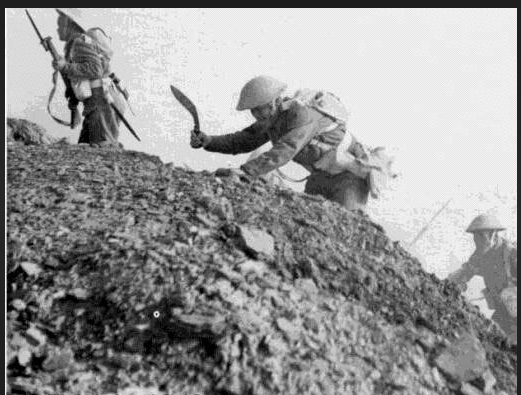
Corporal Arthur Freer of the 3rd Carabiniers was involved in a training exercise in which Gurkhas were told to lie down in front of a Lee tank whilst its 75 mm gun fired over their heads at a bunker 15 yds away. They were then to jump to their feet & rush the bunker. In an interview recorded by the Imperial War Museum (IWM 19822), Freer recalled:
“They were full of volunteers. I said to [their] officer ‘I was very impressed with the way your chaps volunteered.’ ‘Oh’ he said, they always do. Anything we ask them to do, they volunteer. There was one time we were rather worried last year. We asked them if they would jump out of a plane two miles behind the Japanese lines in order to attack them from the rear & only half of them volunteered. We were really worried because usually it’s 100%. But when we told them they’d all have parachutes, we had 100% volunteer.’ That was typical of the Gurkhas.”

After Indian independance, Gurkhas transferred from the Indian Army to the British army, where the Gurkha Brigade continues to serve with distinction.
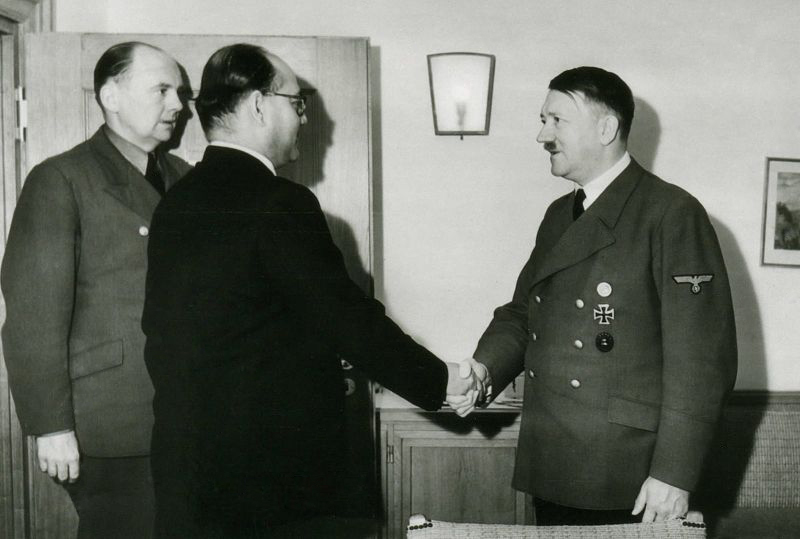
Subhas Chandra Bose had been a leader of the radical, wing of the Indian National Congress, becoming Congress President in 1938. He was replaced in 1939 following differences with other leaders and later placed under house arrest by the British, for promoting civil unrest.
Bose escaped from India in 1941 and traveled to Berlin to appeal to Hitler for support in securing independence for India by force. A brigade was established, termed the Free India Legion, of 4,500 Indians captured by the Germans in North Africa.
Bose then turned to the Japanese and, with their assistance, organised the Indian National Army. A 16,000 strong Division was assembled, composed largely of Indian soldiers of the British Indian Army who had been captured by the Japanese when Malaya & Singapore were conquered. There were executions of some Indian prisoners of war who refused to join the INA.
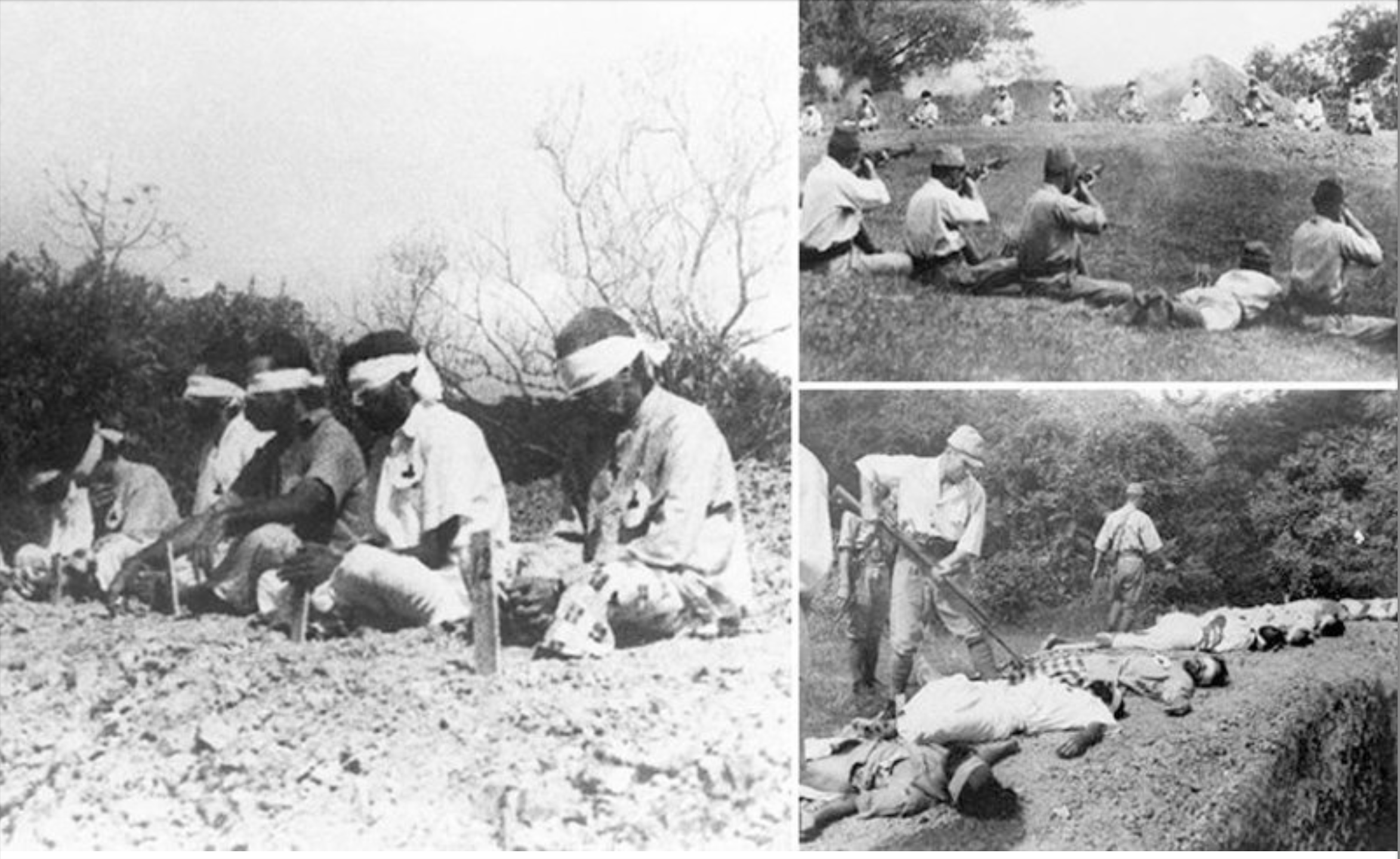
The INA Division supported the Japanese 15th Army when it invaded India in March 1944, urged on by Bose with the slogan “Onward to Delhi”.
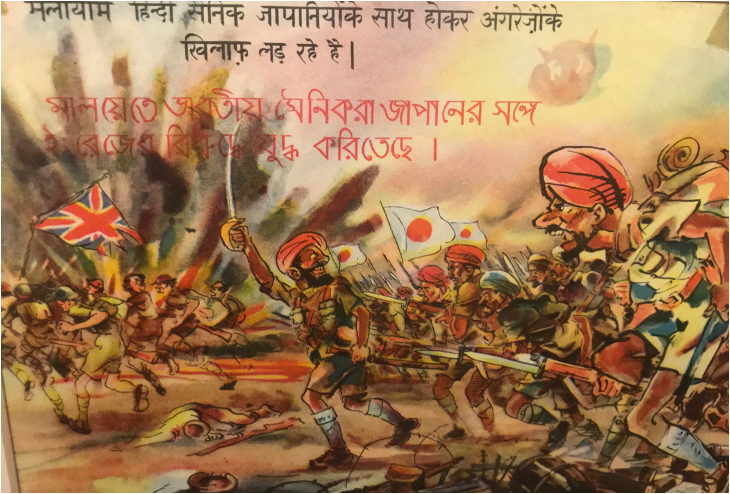
An anonymous Indian corporal explained:
“I joined the INA after hearing Netaji. The Japanese were not cruel to anyone. They said the Asians should fight for their independence, and all Asians should be independent. We were fully confident that the Japanese would hand independence to India, as they had done to the Burmese, the Malays, the Thais; all the Asians. The Japanese remained in Burma because Nehru said on the radio that he didn’t need any help from outside”. (2)
There was no mention of the 14 million, mostly civilians, who died during the Japanese occupation of China. Netaji means “Respected Leader” in Bengali, a title applied to Subhas Chandra Bose.
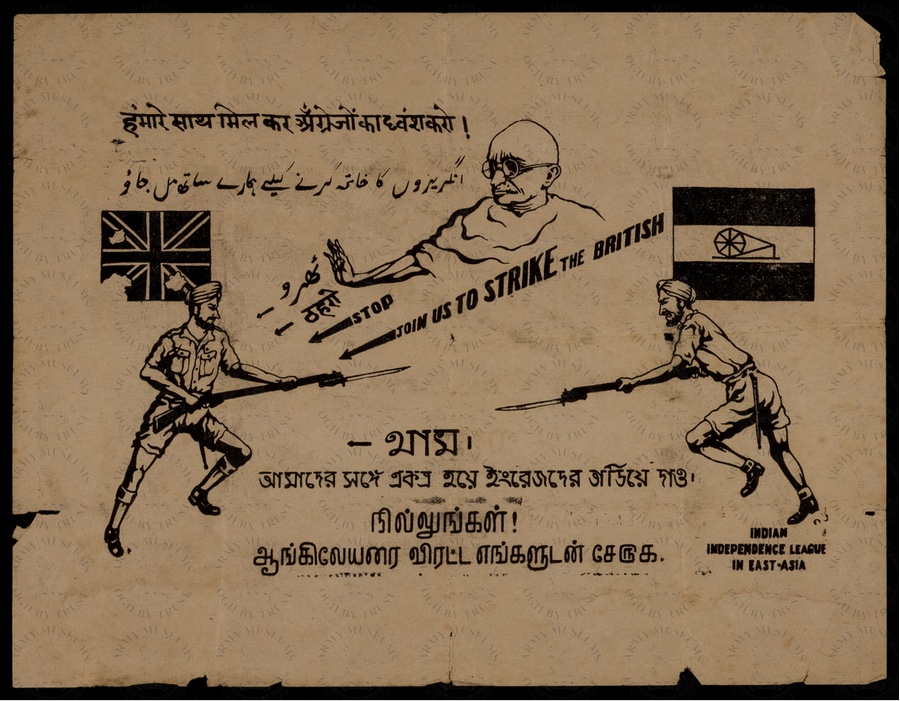
Captain Peter Steyn of 1st Assam Regiment recorded:
“During the night, the Japs would lie in some dead ground & call on the officers & men – both in English & Hindustani – to surrender & to come over & join them as Assam & India were about to fall into their hands. This had no effect on anyone, even when the Japs used our names, which they presumably had got from documents previously captured.” (10)

Despite the civil unrest, more than 2 million Indians volunteered to join the Indian Army & fight alongside the British. It was the largest conscript army in history. Sometimes referred to as the British Indian Army, to avoid confusion with the Indian National Army (INA).
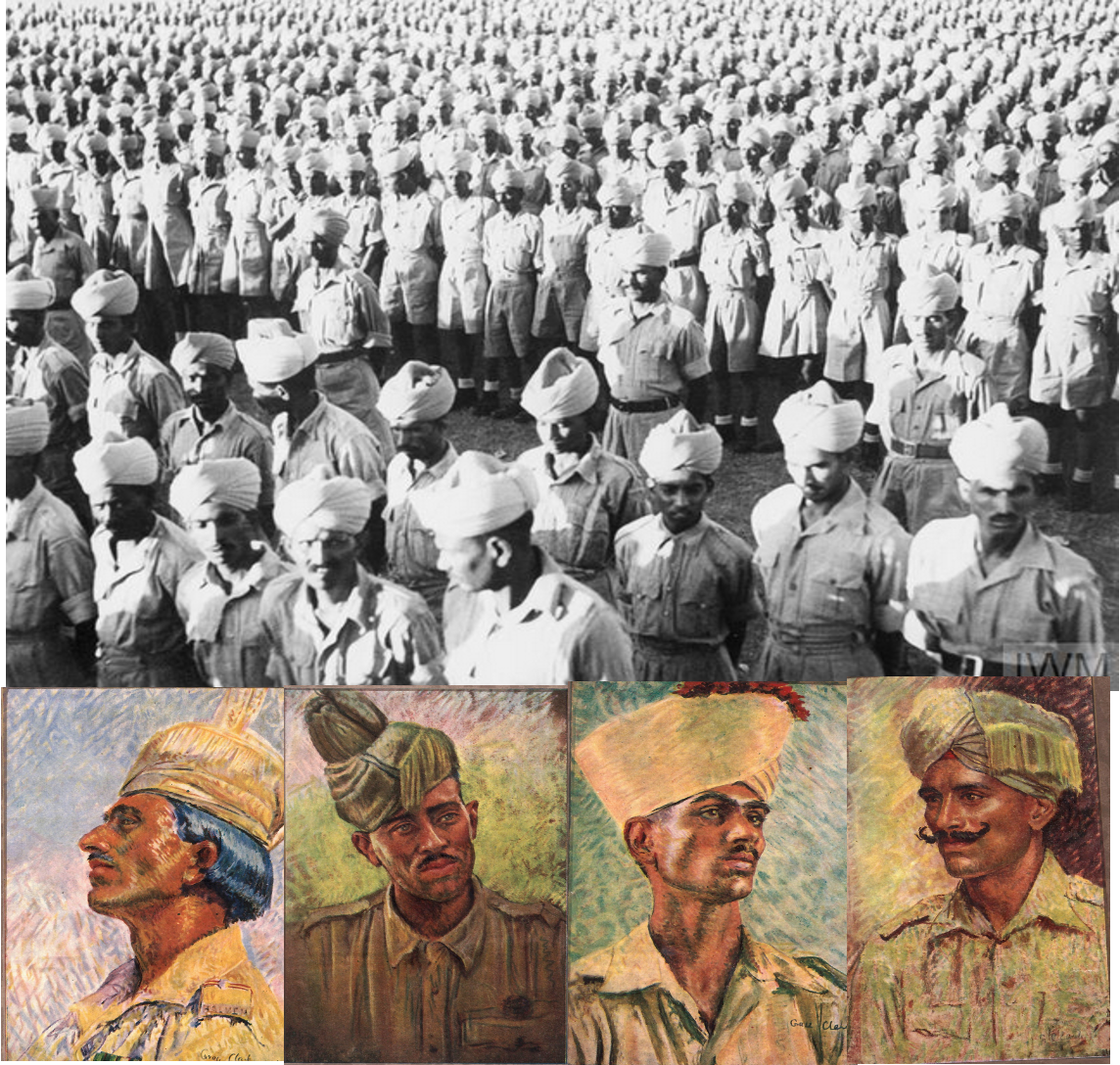
Although junior officers were often Indian, the senior offices were British. Many Indian Infantry Brigades contained one British and two Indian battalions. For example, the 161st Indian Brigade, which stopped the Japanese from taking Kohima, comprised the 4th Battalion Royal West Kents, the 1st Battalion 1st Punjab and the 4th Battalion 7th Rajputs.
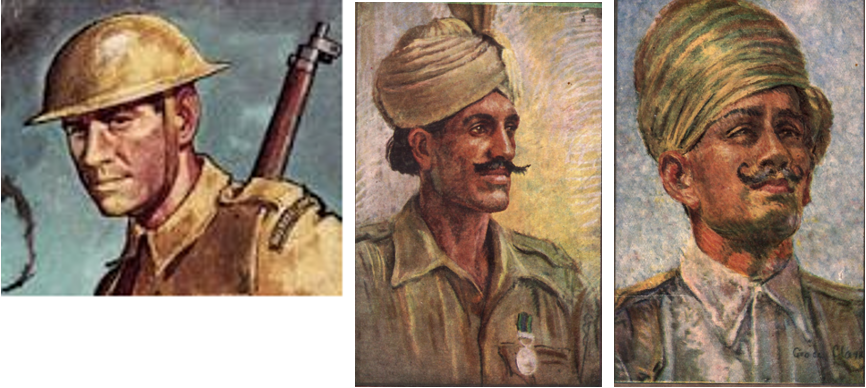
By 1945, 14th Army troops were 87% Indian, 10% British & 3% African. A report produced by the British War Office, based on interrogation of prisoners, was disappointed to record that the Japanese considered that Indians & Gurkhas were better soldiers than the British.
The 14th Army was formed in late 1943 to fight the Japanese. Thirteen infantry divisions served within it, of which eight were Indian, three African and two British.
The British referred to themselves as the Forgotten Army, because press coverage back home always focused much more on events in Europe.
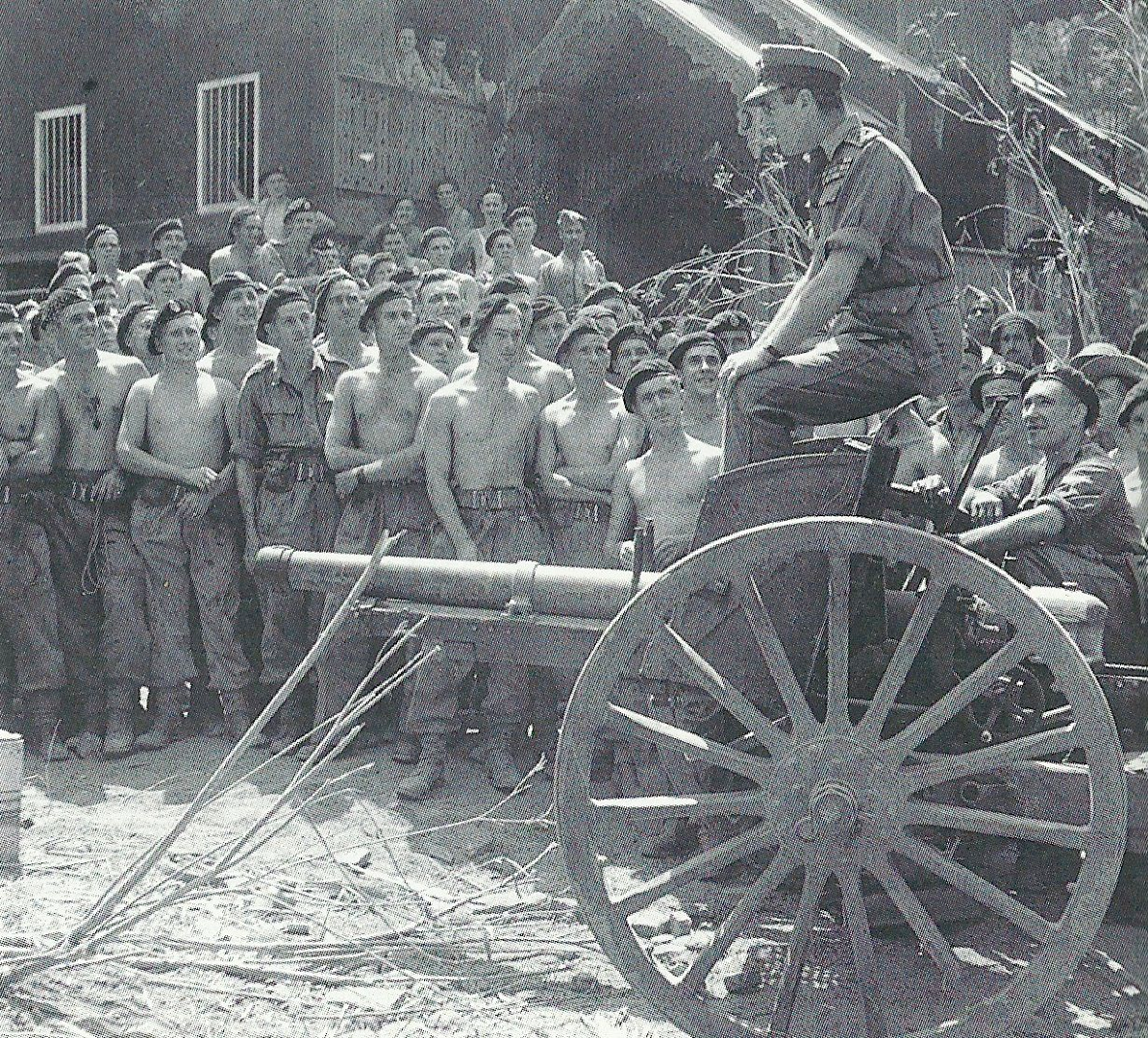
Lord Louis Mountbatten, Supreme Commander South East Asia, used to get a laugh from the troops by joking:
“I know you think of yourselves as the forgotten army, well let me tell you you are not forgotten…”
…pause for effect…
“…nobody even knows you’re here!” (1)
Japanese 31st Division had to cross mountainous jungle terrain to reach Kohima, 120 miles away. There were a few narrow, winding tracks, but no roads that could take motor transport from the frontier. An average infantryman carried about 100 lbs, so heavy that he needed help to stand up; this included his personal supply of rice for 20 days. Mules could carry 160 lb & were used in huge numbers, as were horses.
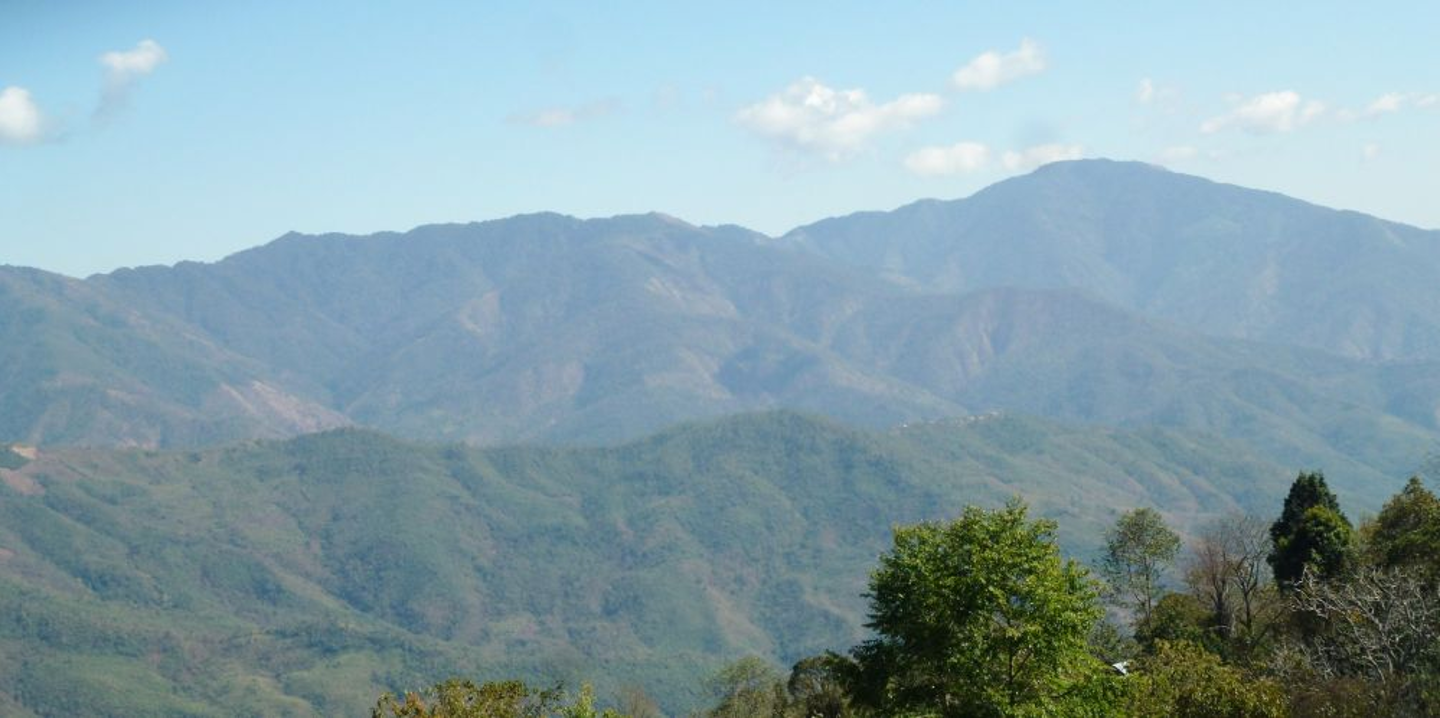
Mutaguchi attempted to use bullocks to transport stores & munitions, providing his army with a source of fresh meat when needed, but these beasts plodded far too slowly. They were used to pulling carts or ploughs, not to carrying burdens on their backs, & they would stop frequently & stubbornly refuse to move. This was hugely frustrating for troops rushing to reach their objective. Captain Shosaku Kameyama expressed the opinion that
“These ideas of our top brass proved to be wishful thinking, which disregarded the harsh reality.” (5)
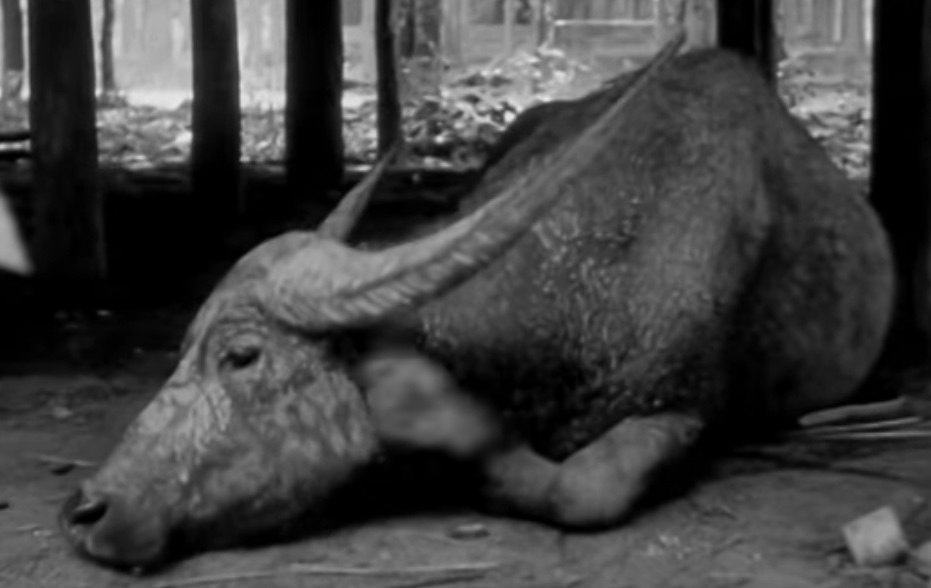
Captain Kameyama recorded that 700 oxen were allocated to his battalion & one of its four rifle companies was converted into a transportation unit responsible for them. This was less than popular for these young fighters, eager to prove themselves in battle.
17,000 of the beasts of burden supporting the Japanese, mules, pack ponies & bullocks, perished in the Invasion of India.